
How to Extend ITSM Frameworks to Legal and Operations Teams: A Step-by-Step Guide

Enterprise Service Management (ESM) brings proven ITSM practices to legal and operations teams. This guide explains how to build service catalogs, create effective request workflows, set realistic SLAs, automate repetitive tasks, and improve visibility without sacrificing professional judgment.
Service Management Architecture: The Missing Foundation for AI and the Intelligent Enterprise
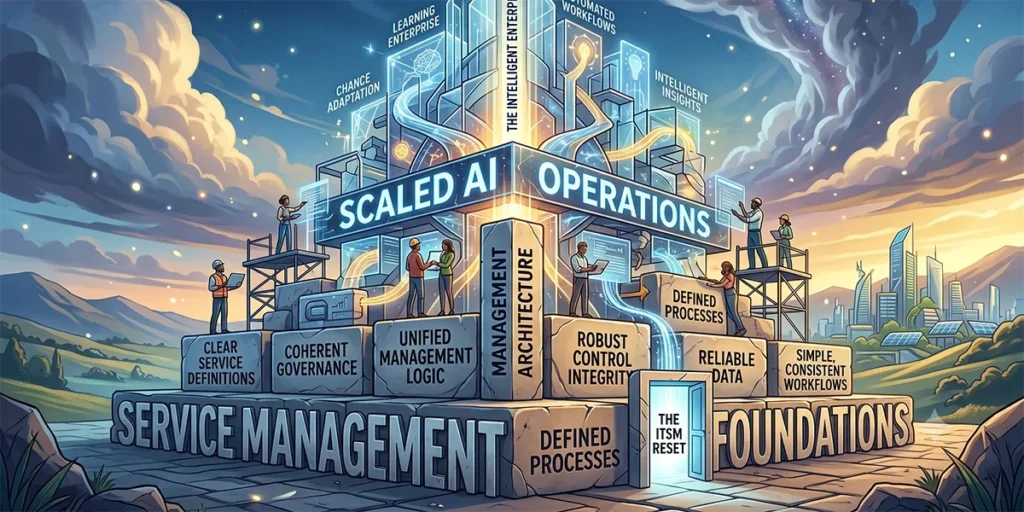
AI can only be as effective as the service management environment that supports it. This article explains why service management architecture, rather than tools alone, provides the operational foundation needed for AI, Agentic AI, and intelligent enterprise transformation.
Why Service Management Is a Human Behavior Problem

Service management frameworks describe what people should do and rarely explain why they don’t. Maarten Bordewijk has spent 30 years arguing that the problem is behavioral, not procedural. In episode 10 of Conversations with Giants, he makes the case for founding the discipline on behavioral science, explains why AI raises the value of human judgment, and gives his blunt verdict on the new ITIL.
When Three Different Vendors Each Say the Outage Isn’t Their Fault

When three vendors each report a different timeline for the same outage, none of them are necessarily wrong, and none of them add up to what happened. This article looks at why multi-vendor outages are becoming the norm as cloud infrastructure consolidates around a handful of providers, why vendor timelines rarely match, and why the only thing an organization fully controls is its own independent incident record.
Microsoft Audits Hosting Providers Every Other Year Now, and Most Have No Governance Plan

Nearly half of Microsoft hosting providers surveyed by SAMexpert were audited or verified within the past twelve months, a rate higher than researchers expected. Most run SPLA without a dedicated owner, and 47% have no audit governance plan at all. Alexander Golev and Daryl Ullman break down what separates providers who can prove their compliance position from those whose confidence has nothing behind it.
Agentic AI in ITSM: 5 Ways Agentic AI Is Transforming the IT Service Desk

For 30 years, the ticket ran the IT service desk: submit, log, triage, resolve, close. Agentic AI in ITSM is retiring that model, executing fixes across systems rather than drafting them for a human to click through. There are five places IT leaders get this transition wrong, from inflated agentic claims to the governance gap most vendor decks skip entirely, and why the ticket itself may not survive the shift.
5 Innovative ITSM Best Practices That Transform Your IT Help Desk

Most IT help desks stop at ticket resolution and leave the rest of the ITSM platform underused. Drawing on customer conversations and internal use at Desk365, this piece lays out five practical ways to push further: QR-code support requests, cross-department automations, AI-generated tickets from meeting notes, a single source of truth, and narrowly trained AI agents. Small changes, real gains in efficiency.
Most Software Buyers Misuse the Gartner Magic Quadrant

Most buying committees treat the Gartner Magic Quadrant as a product ranking, and Keith Andes, a former Gartner analyst, says that’s not what it measures. He walks through what the two axes represent, why leadership position doesn’t equal best fit, and where Gartner Critical Capabilities and the five-step BuySmart process come in once you’ve built a shortlist.
You Can’t Secure What You Can’t See: Why IT Asset Management Is the Foundation of Cybersecurity

You can’t secure what you can’t see. ITAM gives IT teams real-time visibility into who owns every device, what happens to assets during onboarding and offboarding, and how ready they truly are for an audit – closing the gaps that turn into costly incidents.
Seven Signs On-Premises ITSM is Still the Right Call for Your Organization

Cloud ITSM often makes sense, until it doesn’t. The article sets out seven concrete situations, air-gapped networks, sensitive CMDB data, data sovereignty, latency-sensitive change control, total cost of ownership, audit evidence, and vendor lock-in, where an on-premises ITSM tool deployment is the better fit. If two or three apply to your organization, it argues, cloud may not be the safer default it’s assumed to be.
What IT Audits Reveal That Service Dashboards Miss

Dashboards are essential for monitoring operational performance, but they only tell part of the story. This article explores why regular IT audits are critical for uncovering hidden risks, governance gaps, technical debt, ownership issues, and AI-related blind spots that service metrics often fail to reveal. Learn how combining audits with monitoring creates a more complete view of system health and long-term resilience.
A Process Is Still a Conversation: Humanising Service Management

Simone Jo Moore has spent decades arguing that the human sits at the center of every IT process, every tool rollout, every supplier relationship. In her Conversations with Giants episode, she talks about AI as a creative muse and a way to clear the drudgery, why SIAM is a relationship problem at heart, and why she’s still waiting for the industry to drop the dogma and get more honest about the people doing the work.
How IT Support Can Deliver Better Employee Experiences
IT support is usually measured by first-contact resolution and ticket counts, but rarely by whether employees got what they needed. Drawing on a SolarWinds webinar, Stephen Mann looks at why AI’s biggest value lies in preventing issues before a ticket exists, why channel choice counts for more than any single preferred channel, and why most metrics track IT service desk mechanics rather than the outcomes employees experience.
Always-On AI in ITSM: Why Every Service Desk Employee Will Ask “Why Am I Needed?”

Always-on AI is transforming the IT service desk, but technology alone won’t determine its success. This article examines why organizations must address human purpose, psychological safety and governance alongside AI deployment – and why answering “Why am I needed?” may be the most important question of all.
Asset Management Teams Are Being Asked to Govern AI Spend They Can’t See

AI software is the fastest-growing cost in most IT estates, and most teams have no real view of it. The Flexera 2026 State of ITAM Report bears that out: AI tracking is now the field’s biggest challenge, wasted AI spend is climbing, and FinOps is closing in on territory IT asset management used to own. The piece runs through the findings that count for asset and service teams, and what to fix first.