Automation & AI Articles

Christian Nissen spent four decades in IT service management and helped shape ITIL along the way. In his Conversations with Giants episode, he makes the case that the industry keeps isolating capabilities it should be reintegrating, that it has swapped service for product, and that the skills worth learning are older and plainer than newcomers expect. Here are the ideas practitioners can use now.
AI is transforming IT service desks, but not in the way many expect. The real limitation isn’t the intelligence of AI models, it’s the lack of usable, high-quality context within most IT environments. From CMDB accuracy and knowledge articles to service catalogs and tacit expertise, AI is only as effective as the information it can access. Without strong contextual foundations, even the most advanced AI simply scales existing issues. The real opportunity lies in building richer, more reliable ITSM context so AI can deliver consistent, meaningful operational value.
Discover the latest findings from the 2026 HCLSoftware-sponsored ITSM.tools survey on Agentic AI. This article explores AI adoption trends, governance priorities, regional differences, and the correlations between AI maturity, trust, business value, and organizational success, helping IT leaders better understand where Agentic AI is delivering measurable impact in ITSM.
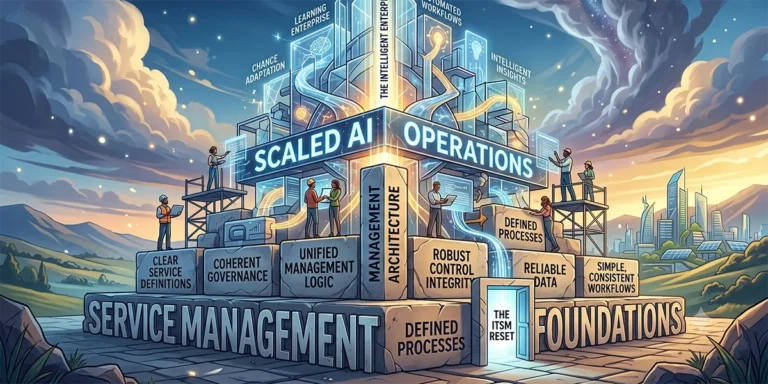
AI adoption in ITSM is nearly universal, but many organizations are discovering that AI can only be as effective as the processes, data, and governance supporting it. New research shows a significant gap between widespread AI implementation and the maturity of underlying ITSM practices. While AI is delivering value through automation, predictive insights, and improved user experiences, it cannot compensate for fragmented workflows, disconnected tools, or inconsistent data. As organizations pursue agentic AI and larger-scale automation, strengthening ITSM foundations (an ITSM reset) may be the most important step toward achieving sustainable AI success.
As AI agents gain autonomy and become embedded in critical business processes, organizations face a growing governance challenge. This article explains how established ITSM capabilities – including risk classification, service ownership, CMDB visibility, change management, incident response, and access governance – can provide a practical framework for AI agent governance. Rather than creating entirely new governance models, organizations can extend existing service management practices to ensure accountability, oversight, and operational resilience in the age of agentic AI.
Many ITSM tool renewals are treated as procurement exercises when they should be strategic business decisions. With AI reshaping service management, increasing pressure to reduce costs, and rapidly evolving vendor capabilities, renewing the status quo is no longer the default choice. This guide outlines a practical 90–180 day framework for evaluating your current platform, assessing alternatives, and building stakeholder alignment before contract renewal. It also covers the seven critical questions every IT leader should answer to determine whether to renew, expand, or replace their ITSM solution with confidence.
AI doesn’t fix broken processes – it scales them. While many ITSM teams focus on automation and autonomous IT service desks, the real determinant of AI success is operational maturity. Learn why knowledge quality, workflow consistency, governance, and data hygiene are the foundations of sustainable AI adoption in IT service management.
The best support tickets are the ones never submitted. And with the emergence of AI, a ticketless enterprise is becoming a reality, allowing Enterprise operations teams to become more effective and less expensive.
Provance ServiceTeam ITSM Enterprise 3.0 continues the platform’s evolution as a Microsoft-centric service management solution built natively on Microsoft Power Platform. Designed for organizations looking to maximize existing Microsoft investments, the solution combines ITIL-aligned service management capabilities with low-code flexibility, workflow automation, AI-driven innovation, and deep integration across Microsoft 365, Azure, Power BI, Power Automate, and related technologies. ServiceTeam ITSM Enterprise 3.0 offers organizations a modern alternative to traditional ITSM tools while leveraging the scalability, security, and extensibility of the Microsoft ecosystem.
Strategic roadmaps are filling up with AI agents, command towers, and intelligent automation. Yet both Agentic IT and third-party risk programs share a hidden constraint that rarely makes it into keynotes: neither can succeed without a trusted, runtime view of what exists, how it is connected, and which services it supports.
A quarter of UK enterprise AI agent deployments aren’t paying back. New research from KTSL and BMC Helix shows the reasons aren’t about the technology.
A shift is beginning, including for self-healing. AI agents are increasingly automating not only operational IT service tasks but also parts of ITSM platform implementation, configuration, and ongoing maintenance. As these capabilities mature, organizations can expect lower costs, less manual intervention, and systems that increasingly manage and optimize themselves.
Mathies Wähner on why Agentic AI fails in ITSM. Drop it into an operating model that isn’t ready and it doesn’t make you smarter, just faster at being wrong, while removing the people who used to catch the mistakes. The real question isn’t how to implement it, but whether your operating model can survive it.
SITS26 brought together ITSM leaders, practitioners, and vendors to explore the future of AI, automation, change management, digital employee experience, and service transformation. Here are some of the biggest lessons and practical takeaways from this year’s event in London.
Somebody announces the death of service management every few years, and they’ve been doing it for 35. Barclay Rae has heard every version and thinks they all miss the same thing: the job at the heart of service management is human, not technological, which is exactly why no new wave of tech has managed to kill it. If anything, AI has made the case for it stronger.