
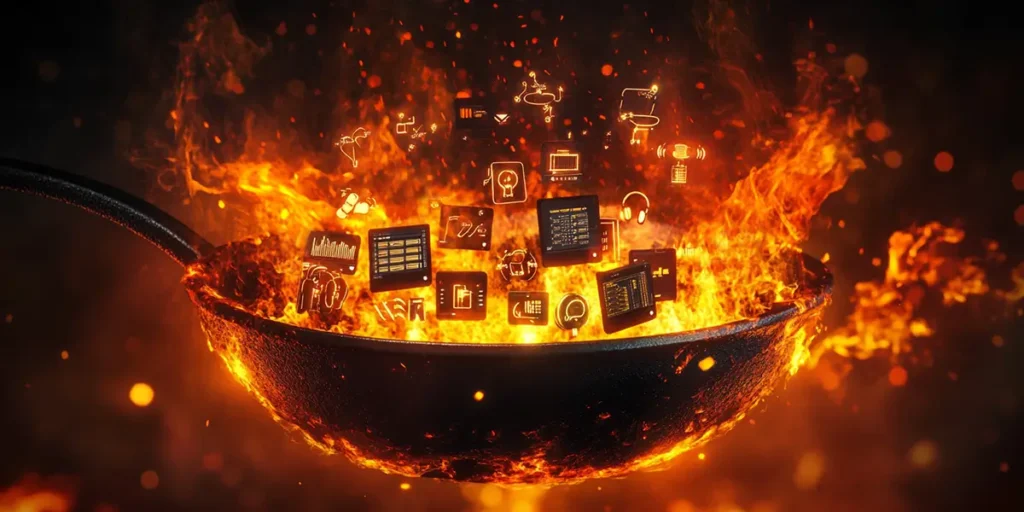
IT service management (ITSM) leaders face major risks in 2026 as artificial intelligence (AI) and automation reshape digital service management. Here’s Ian Aitchison’s view: When recently asked about the primary risk I think ITSM leaders should be focused on for 2026, I stated that I saw not one, but two key ITSM risks that are directly related. Avoiding them both requires “getting out of the frying pan, while avoiding the fire.”
ITSM Risks #1: Staying in the Frying Pan
The first ITSM risk is “staying in the frying pan.” That if you don’t change your mindset (as an ITSM leader) and culture, you are cooked.
In my opinion, it’s becoming a two-tier IT world, where ITSM leaders risk being sidelined, devalued, and ultimately replaced if they don’t transform themselves and their organization into what I consider “Tier-One.” This is explained below.
What Tier-One IT Leaders Are Doing Differently
Tier-One IT leaders:
- Upend the traditional understanding of the purpose of ITSM, particularly related to the IT service desk.
- Are digital experience management (DEX)-centric, embracing AI and automation, and seeking to eliminate all possible future incidents before they happen – remodeling IT and the IT service desk into hunter/proactive DEX-centric new roles.
- Prioritize personal productivity over service delivery, with a focus on developing automation and AI use cases. Saving time.
- Say: “AI and Automation mean that the IT service desk no longer receives or resolves incidents. We don’t do that anymore.”
Tier-Two IT leaders:
- Utilize traditional approaches and focus on opening more channels for reporting faults to IT, including chatbots that only chat, not fix, and self-service portals that only pass work on to others or back to the employee.
- Embrace current ITSM tooling and new AI features, such as generating knowledge base articles, rather than automating the detection and elimination of the causes.
- Say: “AI and automation mean my IT service desk team does the same job faster. They create and close their assigned open tickets even faster. Employees can find advice on how to fix issues themselves more easily.”
Hopefully, the difference between Tier One and Tier Two IT leaders is clear, especially from an ITSM risk perspective.
Why Tier-Two ITSM Is Becoming Obsolete
The world is changing fast, and your business will need a Tier-One IT organization and Tier-One ITSM capabilities. This ITSM risk cannot be ignored. Hence, businesses with Tier Two IT and ITSM must be brought up to Tier One. If necessary, this will be done by replacing all the Tier-Two staff with Tier-One staff.
ITSM Risks #2: Jumping into the Fire
The second ITSM risk is “jumping into the fire,” caused by the proliferation of uncontrolled, hacked, and shadowy tools, as the potential impact of what has been termed “vibe coding” is not well appreciated.
In becoming a Tier-One ITSM leader (detailed above), you must encourage innovation, automation, experimentation, and the adoption of new AI tools. However, this will expose you and your organization to the proliferation of “Shadow Vibe Apps” and the associated ITSM risks.
The Rise of “Shadow Vibe Apps”
We might also call this “Shadow Development” or even “Vibe Hacking.” Regardless of the name, a massive proliferation of self-created apps, public websites, and single-purpose mini-tools will blossom both within IT and across the business. These “Shadow Vibe Apps” are unapproved and insecure, posing a significant ITSM risk. Yet, they are being rapidly created and shared by people in various roles to help them and their colleagues work more effectively. These tools can cause harm, either deliberately or accidentally.
The term “Shadow” is derived from the concept of “Shadow IT,” which refers to non-IT business functions that purchase and use ad hoc third-party tools without undergoing IT, legal, or security checks and balances.
Why Shadow Development Is a Growing Threat
If you thought Shadow IT was bad, at least those unknown tools were from real vendors with reasonable levels of professional operation and security. The usual impact of Shadow IT was “IT doesn’t know how to support this thing.”
Shadow Vibe Apps come from a new breed of creators – not vendors – who are low or semi-technical individuals, hacking their way toward publishing something anyway they can. Can you imagine the conversation that goes “Who made this tool?” “Uh… Bob in Finance, I think.” “Where is Bob?” “Oh, he left six months ago.”
The impact of Shadow Vibe Apps then becomes “Something automatic just shut down half our business, and we can’t restart it.” Or “Our highly sensitive personal customer data has just appeared on public hacker sites worldwide.” And the IT response is “We have absolutely no idea why or how these things happened.” For me, it’s an ITSM risk that cannot be ignored.
How ITSM Leaders Can Mitigate These 2026 ITSM Risks
In terms of addressing these two ITSM risks, the only way to avoid being cooked or burnt is to move out of the frying pan – by becoming a Tier-One IT leader – and then to carefully avoid being burnt by the fire of Shadow Vibe Apps. The big question for ITSM leaders is, “Can you avoid the heat?”
Download the full SymphonyAI white paper: ITSM Risks into Growth Opportunities in 2026
Further Reading

One Response
Great summary, but the tier 1 and tier 2 comments go beyond AI, it’s about rethinking the appropriate organizational structure (50+ yo), into one appropriate for the 21st century services mindset vs. the technology mindset organizational mindset.