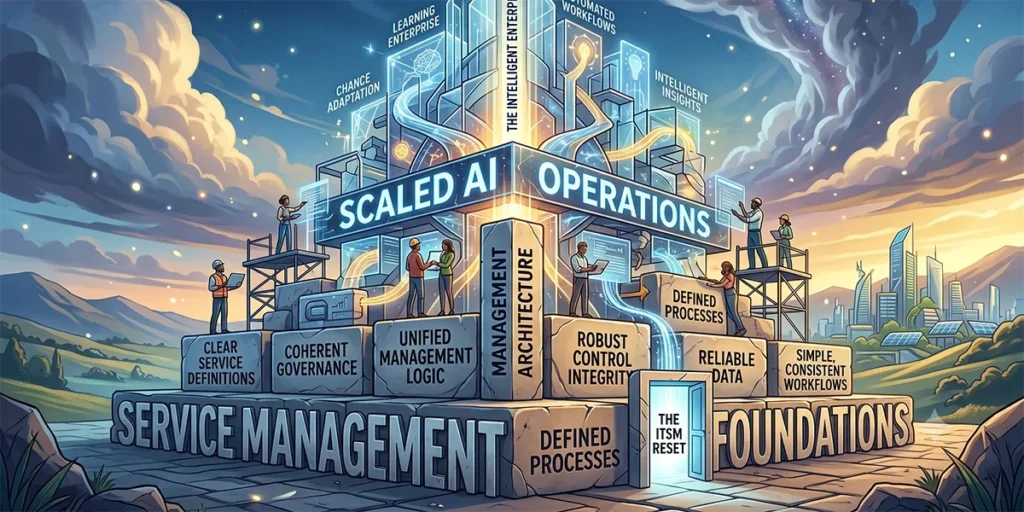
Keith Andes’ recent ITSM.tools article, The ITSM Reset: Why AI Can’t Scale Without Strong Service Management Foundations, makes an important point that deserves more attention. Artificial intelligence (AI) adoption is no longer the interesting question. The more important question is whether the operational foundation underneath AI is strong enough to support it and the intelligent enterprise.
This distinction matters. Many organizations are already using AI in service management, including IT service management (ITSM). Chatbots, task automation, incident prediction, translation, knowledge retrieval, and asset reporting are no longer exotic ideas. They are quickly becoming normal features in the service management platforms and workflows people already use.
But AI does not operate in a vacuum. It operates within the service environment we provide.
AI Adoption Is Accelerating – But Is Your Service Management Ready?
If that environment is fragmented, AI will reflect the fragmentation. If workflows are inconsistent, AI will reproduce the inconsistency. If service definitions are unclear, AI will struggle to interpret what matters. If governance is weak, AI will not magically create accountability. If the data is unreliable, AI will retrieve unreliable answers faster and with more confidence.
That is not intelligence.
That is acceleration without architecture.
An intelligent enterprise needs more.
Why an ITSM Reset Alone Isn’t Enough for the Intelligent Enterprise
I agree with the call for an ITSM reset. Simplifying core processes, reducing tool sprawl, improving integration, strengthening governance, embedding security, and measuring outcomes are all essential.
But I would suggest it may not go all the way to the heart of the matter.
Practice maturity will continue to matter. But before we rush to improve maturity scores, we should understand what kind of gap we are dealing with.
Is your organization unclear about value posture – who is being served, what outcomes matter, and what commitments define success?
Or is your organization struggling with control integrity – ownership, workflow, decision rights, visibility, risk, security, recovery, and learning?
These are different issues. AI will not treat them kindly if they are blurred together.
This is where Dual Lens thinking can help. It separates the question of whether we are aiming for the right outcomes from the question of whether we have sufficient management control to deliver those outcomes reliably. Both matter. But they should not be collapsed into a single maturity score or hidden behind a service management platform implementation plan.
This is also where service management architecture becomes important.
By architecture, I do not mean technology architecture. I mean management architecture: the underlying structure by which services are defined, governed, delivered, changed, restored, improved, and learned from.
Technology architecture is essential. But technology architecture should not be confused with the management architecture that determines how service work is understood, owned, controlled, and improved.
This is not just an ITSM question. It is not only a tool question, either.
ITSM is often where the pain first becomes visible because IT is usually the function being asked to support automation, integration, digital workflows, and now AI. But the underlying management problem is not unique to IT. HR, facilities, finance, legal, customer support, security, operations, and external service providers all face similar challenges.
They all provide services, make commitments, handle recurring situations, depend on workflows, and need clear ownership, decision rights, information, and learning.
That is why the intelligent enterprise cannot be built only by adding intelligence to existing tools. It requires a management architecture that is clear enough for people to govern and consistent enough for AI to support.
Service Management Tools Matter, But They Are Not the Management System for an Intelligent Enterprise
This is where many organizations get into trouble.
A service management platform can be extremely useful. A well-configured ITSM tool can improve visibility, standardize workflows, support automation, and enhance the user experience. AI features inside these platforms can add even more capability.
But the service management tool is not the management system.
The service management tool can automate a workflow, but it does not decide whether the workflow makes sense. It can route work, but it does not clarify whether ownership is right. It can expose data, but it does not guarantee that the data reflects a coherent service model. It can enforce approvals, but it does not determine whether those approvals protect the critical path or merely preserve local habits.
In my work with service organizations, I have rarely seen poor results caused by a lack of effort. More often, people are working hard inside structures that make coherent service delivery harder than it needs to be. Teams optimize locally. Tools are configured locally. Metrics are interpreted locally. Then, when leaders ask for enterprise-wide visibility or AI-enabled automation, the organization discovers that the hard part was never the automation. It was the management architecture underneath it.
This is one reason why so many organizations feel both overcontrolled and undercontrolled at the same time. They have plenty of approvals, routed tasks, dashboards, policies, and tool configurations. And yet the customer experience remains inconsistent, accountability remains fragmented, and service management leaders still struggle to understand where value is created or where control is failing.
AI will not remove that issue. In many cases, it will expose it faster. Service management needs management architecture.
What Is Service Management Architecture?
When I use the phrase service management architecture, I mean the stable management logic that sits beneath practices, procedures, service management tools, and organizational structures.
Practices matter. ITIL, DevOps, Agile, Lean, COBIT, SIAM, SRE, ISO standards, enterprise architecture, and security frameworks can all provide valuable guidance. But practices work best when they are connected through a coherent management system.
Without that architecture, organizations often try to “align” practices after the fact. Each team adopts its own language, workflow, tool configuration, and interpretation of what good looks like. Then enterprise leaders wonder why integration is so difficult.
The issue is not that people lack effort. The issue is that the enterprise has allowed local routines to obscure the underlying service management logic.
That is where the Unified Service Management (USM) method is worth considering.
Unified Service Management (USM) Explained
USM is not an ITSM tool. It is not limited to IT. It is not a replacement for every existing framework or practice. It is a method for defining a universal service management system based on a simple, consistent management architecture.
It is also intentionally accessible. USM is intentionally simple; its knowledge products are publicly accessible, and the method is maintained by the non-profit SURVUZ Foundation, which makes free knowledge products available to service organizations of any size and in any line of business. That matters because the problem USM addresses is not proprietary. Every service organization needs a way to define, govern, deliver, change, restore, and improve services coherently.
There are, of course, other ways to improve management coherence. My point is not that every organization must adopt USM. My point is that every organization needs some explicit management architecture before it scales AI-enabled service operations.
The value of USM is not that every team becomes identical. They should not. Different services, industries, risks, customers, and technologies require local variation. The value is that local variation is anchored to common management logic.
In practical terms, that means an organization can distinguish between the stable structure of managing services and the local routines used to execute work in a particular context. That distinction becomes increasingly important as AI enters the picture.
AI needs patterns, boundaries, reliable data, decision logic, clear service definitions, and coherent governance. If we do not provide those things, AI will infer patterns from whatever mess we have already created. This may be useful in small doses. It is dangerous at scale.
Intelligent Enterprises Need More Than Automation
The phrase “intelligent enterprise” can easily become another technology slogan. But if we take it seriously, intelligence should not mean more automation alone.
An intelligent enterprise should be able to understand its services, know who it serves, understand the commitments it has made, see where work gets stuck, identify which controls matter, and learn whether the customer, end-user, or business outcome is actually improving.
That is a management challenge before it is a technology challenge.
AI can help, but only when the enterprise has enough structure to make learning useful. Otherwise, AI simply produces faster summaries of poorly understood work.
This is where Dual Lens thinking becomes practical. Dual Lens is a plain-English way to avoid confusing two different questions. First, are we focused on the right customer, end-user, business, or stakeholder outcomes? Second, do we have enough ownership, workflow clarity, decision rights, visibility, stability, and learning to deliver those outcomes reliably?
Both questions matter. But they should not be collapsed into one vague maturity score. An organization can have a compelling customer vision and still lack the control integrity to deliver it. That produces beautiful designs that cannot survive contact with operational reality.
The reverse is also true. An organization can have efficient workflows, strong internal discipline, and impressive dashboards while still delivering outcomes customers do not value. That produces efficient work that does not matter enough.
AI can make either issue worse. It can help an organization deliver the wrong thing faster. It can scale inconsistent work more broadly. It can hide weak accountability behind fluent answers.
But it can also help an organization learn, adapt, and improve when the management architecture is clear.
That is the choice in front of us.
Five Practical Steps to Improve AI Readiness
A practical starting point does not require a major transformation program. Start with one important service, preferably one already being considered for AI-enabled improvement. Then work through five questions.
1. Define the service
What outcome does the service enable, who consumes it, and what commitment has been made?
2. Separate the recurring work
Which situations are requests, changes, disruptions, operational tasks, risks, or improvements?
3. Clarify ownership
Who owns the service, the workflow, the decision, the data, and the control?
4. Test the Dual Lens
Is the real gap value posture, control integrity, or both?
5. Only then look at automation (in intelligent enterprise terms)
Where can AI safely assist, recommend, summarize, route, detect, or act?
This small exercise often reveals whether the organization has an AI opportunity, a tool configuration issue, a data issue, or a more fundamental management architecture issue. It also helps avoid a common trap: using AI to compensate for unclear management rather than to improve a management system that is already becoming clearer.
The ITSM Reset is a Doorway for the Intelligent Enterprise
The ITSM reset is necessary. But perhaps it should be treated as a doorway into a larger enterprise conversation.
The immediate issue may be AI readiness in ITSM. The larger issue is whether the organization has a service management system that can support intelligent operations across the enterprise.
That broader conversation should include tools but not start with tools. It should include ITSM practices but not be limited to ITSM. It should include AI, but not assume AI can compensate for unclear services, fragmented ownership, weak governance, poor data, or inconsistent workflow.
The starting point is simpler and harder:
What services do we provide? Who are the customers and users? What outcomes matter? What commitments have we made? What recurring situations must we manage? Who owns the decisions? Where does work flow? Where does it stall? Which controls protect service integrity? Which controls merely compensate for weak design?
These are not glamorous questions. But they are the questions that determine whether AI becomes useful intelligence or just another layer of operational complexity.
Agentic AI raises the stakes because it moves us from AI that suggests to AI that acts. Before organizations give AI more autonomy, they need to be much clearer about the service environment in which that autonomy operates. The issue is not only whether the AI model is powerful enough. It is whether the management system is coherent enough.
Can the agent understand the service? Can it distinguish a request from an incident, a change, a risk, or an improvement? Can it act within defined authority? Can it escalate when judgment is required? Can it use reliable knowledge? Can it preserve security and compliance? Can the organization see what happened, learn from it, and improve the system?
Those are service management architecture questions.
How Unified Service Management Creates Consistency
USM offers one practical approach because it focuses on the universal logic of service management before local practices and tool variations are introduced. Dual Lens can then help leaders keep two perspectives in view: the value being pursued and the control integrity needed to deliver it reliably.
Neither USM nor Dual Lens eliminates the need for good tools, good data, good leadership, good security, or good execution. But they can help organizations ask better questions before they automate the wrong answers.
The Future of AI Depends on Better Service Management
The intelligent enterprise will not be created by AI alone. It will be created by organizations that understand their services, simplify their management systems, clarify decision rights, improve the quality of their data, embed governance into everyday work, and use AI to strengthen, rather than bypass, human accountability. That is why service management architecture matters. It gives AI something coherent to support.
Without it, organizations may still deploy impressive capabilities. They may still report quick wins. They may still improve isolated tasks. But scaling intelligence across the enterprise will remain difficult because the enterprise itself will remain structurally unclear.
The future does not belong to organizations that simply add AI to fragmented service management. It belongs to organizations that make service management clear enough for AI to help and to bring about the desired intelligent enterprise.
Intelligent Enterprise FAQs
Service management architecture refers to management architecture: the underlying structure by which services are defined, governed, delivered, changed, restored, improved, and learned from. It’s distinct from technology architecture, which is essential but shouldn’t be confused with the management structure that determines how service work is understood, owned, controlled, and improved.
Simplifying core processes, reducing tool sprawl, improving integration, and strengthening governance are all essential, but the article argues this doesn’t go all the way to the heart of the matter. Before organizations rush to improve maturity scores, they need to understand whether they’re facing a value posture gap, a control integrity gap, or both, since AI treats those as different problems.
Dual Lens thinking is a way of separating two questions that often get collapsed into one vague maturity score: whether an organization is focused on the right customer, end-user, or business outcomes, and whether it has enough ownership, workflow clarity, decision rights, and visibility to deliver those outcomes reliably. An organization can have a compelling vision and still lack the control integrity to deliver it, or efficient workflows that deliver outcomes nobody values.
USM is a method for defining a universal service management system based on a simple, consistent management architecture. It isn’t an ITSM tool, isn’t limited to IT, and isn’t a replacement for existing frameworks like ITIL, DevOps, or COBIT. Its knowledge products are publicly accessible and maintained by the non-profit SURVUZ Foundation, available to service organizations of any size and industry.
The article sets out five steps, starting with one service already being considered for AI-enabled improvement: define the service and the commitment it represents, separate the recurring work into requests, changes, disruptions, risks, and improvements, clarify who owns the service and its decisions, test the Dual Lens to identify whether the gap is value posture or control integrity, and only then look at where automation can safely assist.

John Worthington
John Worthington is a Certified Unified Service Management (USM) Professional and founder of MyServiceMonitor, residing in the NYC area. He helps organizations simplify service management using the USM method, with a focus on management clarity before tools, frameworks, and automation. John writes and advises on enterprise service management, AI readiness, governance, and Dual Lens thinking.