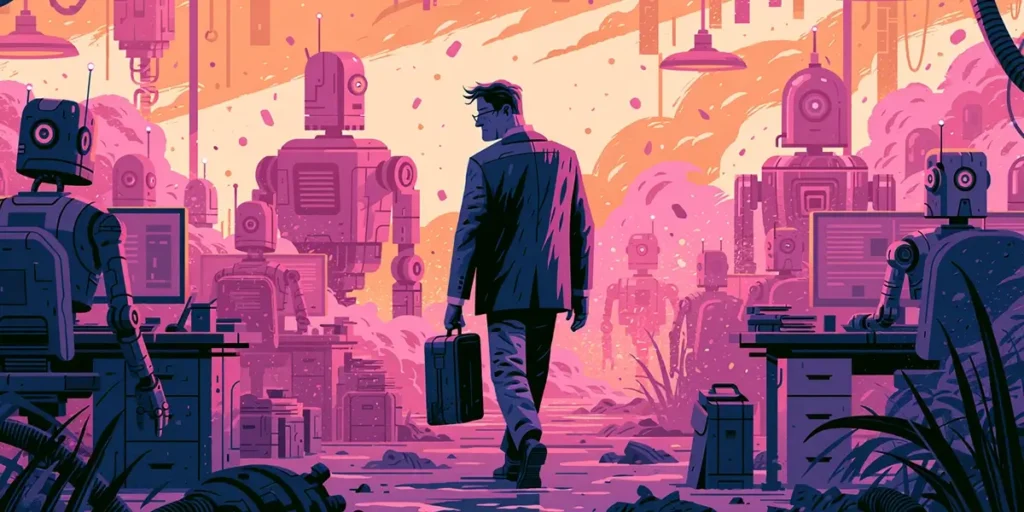
It is 2 am. A major incident is underway. The artificial intelligence (AI) has already requested a fix, coded it, tested it, deployed it, verified it worked, drafted the incident report, identified the known error, cross-referenced the last three occurrences, and briefed management. Your service desk analyst is watching it unfold in real time. The question forming in their mind is not technical. It is existential: Why am I needed? Always-on AI is transforming how organizations work, including in terms of IT service management (ITSM) capabilities.
The Human Question Behind Every AI Deployment – “Why am I needed?”
This is the question no vendor marketing addresses. It will determine whether always-on AI transforms your IT service desk or quietly hollows it out. By July 2026, with three of the world’s largest AI providers having launched always-on, channel-resident AI agents, it is the question every IT leader must answer before signing anything.
From COBOL to AI: Every Technology Shift Changes People
In 1970, if you worked in IT, you worked in FORTRAN, COBOL, or LISP. By the early 1980s, Pascal and C had arrived, and a generation of practitioners was being forged – not by tutorials, but by systems that punished sloppiness. The AS/400. Tandem NonStop. Mainframes run stock exchanges and gambling floors. Excellent teachers, all of them.
When those systems ran COBOL (or their preferred language) to settle trades or calculate odds in real time, the operators knew exactly what was happening and why. Accountability was absolute. If the computer went down, it was due to a hardware failure, a software defect, or human error – and you found out which rather quickly.
Now meet the AI-native generation. Their COBOL is Python. Their first experience of writing software often involves prompting an AI rather than writing a line of code. The testing gap this creates – over-relying on the AI that wrote the code to validate it – will eventually arrive on the IT service desk’s doorstep at 2am. Every transition in how we build and deploy technology carries a human cost that precedes any productivity gain. AI is no exception.
Always-On AI Agents Have Arrived
Over the past four months, the three dominant AI providers have each launched the same core product: an always-on AI agent embedded within enterprise collaboration platforms, continuously accumulating organizational context and executing multi-step tasks asynchronously – whether or not anyone is watching:
- Anthropic launched Claude Tag in June 2026 – an always-on AI agent embedded in Slack that reads channels, builds organizational memory, and acts under a shared organization-level identity.
- OpenAI launched Workspace Agents in April 2026 via ChatGPT Business and Enterprise – operating across Slack, Google Drive, Salesforce, GitHub and 60+ connectors, continuing work even after the person who assigned the task has moved on.
- Microsoft launched Copilot Cowork in March 2026 via its Frontier program – a shared, multiplayer AI agent that retains context across an entire team, built in part on Anthropic’s Claude.
These are not chatbots in a sidebar. They have their own service accounts, remember every decision, monitor channels continuously, and keep working after everyone has logged off. The race to own the ambient layer of enterprise infrastructure (and beyond) is underway. Organizations need to be ready – not just technically, but humanly.
The Opportunity for IT Service Management
The DevOps promise – context flowing automatically from incident to ticket to code change, with no more “I didn’t know that change was happening” – was right. Jira and GitHub delivered it for developers but largely missed the IT service desk. Ambient AI genuinely could change that.
An analyst asking, in plain English, what changed in the last 24 hours and getting a real answer. An AI that has already seen the known error three channels ago and surfaces it unprompted. A management briefing drafted from the incident thread rather than from someone’s exhausted memory. Every tier of the IT service desk is supported by an intelligence layer that understands the organization because it has lived in it.
The technical capability exists today. But the vision only holds if the humans in the channel still know why they are there.
Technology is Advancing Faster Than Society’s Ability to Understand, Govern, or Trust It
Stanford’s 2026 AI Index Report found that the technology is advancing faster than society’s ability to understand, govern, or trust it – marked by expert excitement alongside measurable public fear about identity, jobs, and control. In the IT service desk, that tension is not abstract. It is the analyst watching the AI do the job they were hired to do, faster and more completely, and asking: What is my value here?
Research describes what happens when that question goes unanswered. Pride fades. Confidence wobbles. Effort shifts from impact to optics. A Harvard Business Review analysis calls it “AI brain fry” – mental fatigue from sustained AI oversight, where monitoring outputs you do not fully understand at a pace the AI sets produces higher cognitive strain and burnout.
A Spring Health 2026 survey of 1,500+ employees found that AI had worsened mental health through information overload for nearly a quarter of respondents and reduced their sense of control for almost as many.
The always-on nature makes this acutely worse. A colleague who goes home at 6pm is manageable. One who never sleeps, never forgets, never has a bad day, and is always better-informed – that is a different psychological proposition. The AI is not doing anything wrong. But the effect on the human next to it is real, documented, and entirely predictable.
The Hidden Always-On AI Risk: Psychological Safety
Stigma thrives in environments where exclusion or poor wellbeing thrives. It maps directly onto what always-on AI does to a team. The AI has power by design – institutional memory, tireless availability, and cross-organizational visibility no human can match. The paranoia this generates is not a weakness. It is a rational response to a visible shift in the power dynamic.
The familiar Stigma villains find new form:
- Anxiety – the persistent hum of not knowing whether your contribution is still needed or whether the next restructure targets your role.
- Stress – wondering if you will have a role to pay the bills or the training to be AI-native.
- Depression – giving up.
- Burnout – not from overwork, but from being unable to participate at the pace required to maintain the hundreds of services organizations provide.
When AI handles institutional memory and first-line analysis, human development stalls. Research describes “capacity-hostile environments” that erode critical thinking and the tacit knowledge that makes experienced practitioners irreplaceable. Stanford data shows that entry-level employment in AI-exposed roles has already fallen sharply among workers aged 22 to 25. The pipeline of future expertise is narrowing as deskilling accelerates.
This is not an argument against the technology. It is an argument for treating the human impact as a first-class requirement, not an afterthought.
The Commercial Challenges of Ambient AI
Tokens made sense when AI was transactional. Ambient AI is continuous – reading, building context, and acting, whether or not anyone has asked. Billing by token in that environment is like charging for electricity by counting electron movements. OpenAI’s own product head has compared unlimited AI plans to “unlimited electricity.” This signals that the commercial model is already under review before most enterprises have deployed it. Remember the cloud-costing issues?
In my view, none of the three vendors has produced a cost model that a CFO can plan against. Per-channel token limits are a guardrail, not a model. Nobody truly knows what the true cost of always-on enterprise AI is at scale. Granting any AI persistent access to institutional memory raises vendor lock-in to a new level – you are not buying a tool; you are potentially renting your own organizational knowledge back at a rate not yet defined, with data retention terms not yet disclosed.
What Experienced IT Leaders Already Know
The AS/400 and Tandem NonStop taught that availability is engineered, not assumed; that redundancy is insurance, not waste; and that Operations is a discipline. But they also taught that the people operating them were not incidental – they were central. The Tandem operator who calmly handled a mid-transaction hardware failure did so because they understood the system, had been trained to anticipate failure, and knew their judgment was required.
AI enables. It does not decide, judge, or care. The human does all three.
Stanford confirms it: workers who use AI to enhance their judgment rather than replace it are far less likely to be replaced. The Tandem operators were not threatened by the systems they ran. They were essential to those systems – because good leadership made that clear.
Questions Every Organization Should Ask Before Deploying AI Agents
Commercial and governance:
- What does this cost when 500 people use it across 200 channels, 24 hours a day, for a month?
- How long does the AI retain channel history?
- Who owns that data if we leave the platform?
- What is the accountability chain when AI acts on a conversation or set of alerts and gets it wrong?
- What is our exit strategy if organizational memory is built inside one AI vendor’s platform?
Human – equally non-negotiable:
- Have we addressed the question “Why am I needed?” for every role working alongside this AI? Can we provide this response to our staff in honest conversations?
- Do we have a mental health strategy alongside the deployment strategy of Ambient or Agentic AI?
- How are we ensuring the AI augments human judgment rather than replacing it?
- Who is responsible for the psychological safety of teams working alongside always-on AI?
- How do we create space for people to say “I don’t understand what it did” without it being visible as a performance failure?
AI anxiety is measurable, predictable, and preventable. Spring Health’s 2026 research is unambiguous: this is a documented psychological response, not a theoretical fear.
Predictive models estimate that rapid technological change without human-centered support will trigger anxiety in up to 81% of workers. MIT Sloan and Bain both suggest a more viable approach: deploy AI to augment human expertise, back it with honest communication and proper training, and anxiety will drop measurably. If anxiety drops, the impact of the Stigma villains Stress, Depression, and Burnout will also diminish.
AI Success Depends on More Than Technology
Ambient AI, at its best, is the institutional memory that bridges the generational gap – always on, always informed, surfacing the right context at the right moment. But institutional memory without human judgment is just data. An IT service desk without psychological safety is not a service desk. It is a monitoring function staffed by people who have stopped believing their presence matters.
The difference between these two outcomes is not the technology. The difference is whether leaders treat “Why am I needed?” as a question deserving a real answer – before deployment, not after the first resignation or redundancy.
Written by Daniel with the assistance of Claude (the Alfred to his Bat Dan).
Always-on AI FAQs
Always-on AI refers to agents that live continuously inside enterprise platforms like Slack or Microsoft 365, rather than responding only when prompted. They build organizational memory over time, execute multi-step tasks without supervision, and keep working after everyone has logged off. It’s a different proposition from a chatbot in a sidebar, since the AI accumulates context and takes initiative on its own.
Three major providers launched always-on, channel-resident agents within a few months of each other in 2026. Anthropic launched Claude Tag in June, an agent embedded in Slack that reads channels and builds shared organizational memory. OpenAI launched Workspace Agents in April, operating across Slack, Google Drive, Salesforce, GitHub, and other connectors. Microsoft launched Copilot Cowork in March through its Frontier program, a multiplayer agent built in part on Anthropic’s Claude.
A colleague who goes home at 6 pm is manageable. One who never sleeps, never forgets, and is always better informed changes the power dynamic on a team in a way earlier tools didn’t. This article argues that this isn’t a flaw in the AI itself; it’s a predictable human response to a visible shift in who holds institutional knowledge.
This article splits these into commercial and human categories. On the commercial side: what the AI costs at full organizational scale, how long it retains channel history, who owns that data on exit, and what the accountability chain looks like when the AI gets something wrong. On the human side: whether every role working alongside the AI has a real answer to “why am I needed,” whether there’s a mental health strategy alongside the deployment strategy, and who is responsible for the psychological safety of teams working next to it.
This article cites Stanford research indicating that workers who use AI to enhance their judgment, rather than replace it, are far less likely to be replaced themselves. It draws a parallel to earlier generations of IT operators, who weren’t threatened by the systems they ran because they were treated as essential to those systems.
Further Reading
- https://itsm.tools/gartner-magic-quadrant/
- https://itsm.tools/it-asset-management-cybersecurity-visibility/
- https://itsm.tools/seven-signs-on-premises-itsm-is-still-the-right-call-for-your-organization/

Daniel Breston
Daniel Breston is a 50+ year veteran of IT, ex-CIO and principle consultant, multiple framework trainer, blogger, and speaker. Daniel is on the board of itSMF UK and is a Fellow of the British Computer Society. Daniel may be retired, but he will help an organization if requested. Not full-time, but hey!