

The Gartner Magic Quadrant might be the most misunderstood document in enterprise software.
If your buying committee is choosing software (such as an IT service management (ITSM) platform) based solely on the Gartner Magic Quadrant, I’ve got some wild news for you: the Gartner Magic Quadrant was never intended to tell you which product to buy.
It’s not even a product evaluation.
In this article, you’re going to learn everything you need to know about the Gartner Magic Quadrant and how to use it. Even more importantly, I’ll give you a full rundown of Gartner’s recommendations for buying enterprise software.
A Gartner Insider’s Perspective
Before we dive in, a quick disclaimer. I’m Keith Andes, a former Gartner analyst and co-author of the Gartner Magic Quadrant for IT Service Management in prior years. Today I lead Product Marketing and Analyst Relations at EasyVista, one of the vendors evaluated in this market.
This article isn’t intended to convince you to buy EasyVista. EasyVista may be the right fit for many organizations, while others will find that a different solution better matches their needs. My goal is simply to help ITSM platform buyers understand how Gartner intended this research to be used so they can make a better purchasing decision.
Get the Gartner Magic Quadrant for ITSM Platforms for Free
If you don’t already have a copy of the Gartner Magic Quadrant for ITSM Platforms, you don’t need a Gartner subscription. Gartner allows participating vendors to license the report, enabling them to legally share it with prospective ITSM platform buyers. This means you can download the report for free from most vendors included in the evaluation (including EasyVista! Download the latest Gartner ITSM Magic Quadrant HERE).
An Ex-Gartner-Analyst’s Insights into the Magic Quadrant
I’m obviously not going to share anything proprietary about Gartner’s methodology. But after spending years helping build this research, and now sitting on the vendor side watching organizations use it to make purchasing decisions, I can explain many of the common myths surrounding the Gartner Magic Quadrant, how Gartner intends buyers to use the research, and how Gartner’s broader “Gartner BuySmart” methodology approaches enterprise software selection.
Whether you’re a Gartner client with access to Gartner’s full research portfolio or have simply downloaded a copy of the Gartner Magic Quadrant from a vendor’s website, understanding what the report is and what it isn’t will help you make a better software buying decision.
McDonald’s is the Market Leader in Fast Food. Does That Mean Everyone Will Eat There?
Gartner doesn’t publish a Magic Quadrant for the fast-food industry, so I created my own ranking to illustrate a buying decision everyone understands.
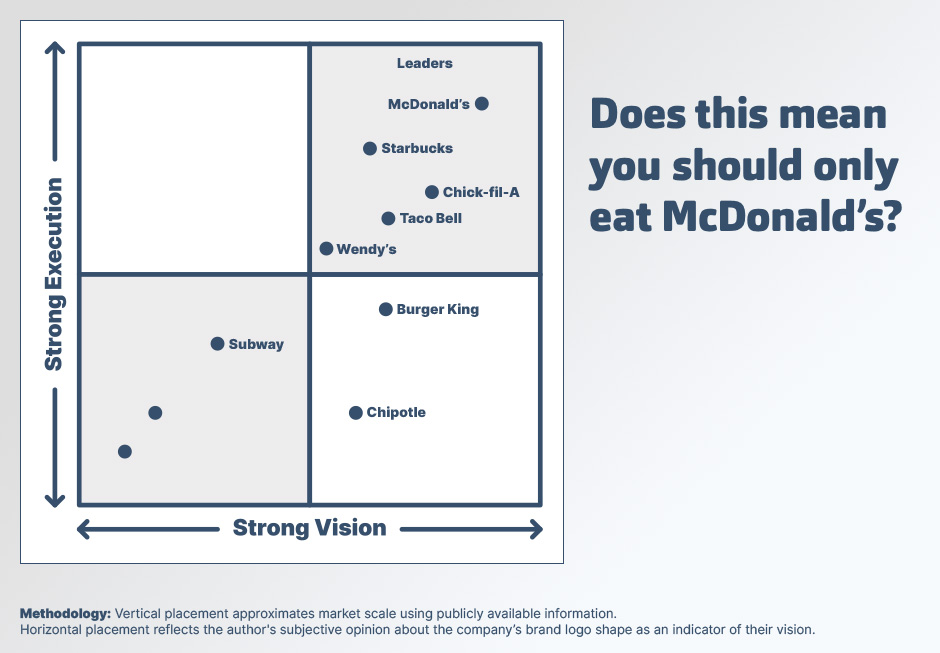
People choose restaurants for different reasons. Some prioritize price. Others prioritize convenience, speed, menu variety, atmosphere, dietary preferences, or simply what they’re in the mood for. Being a market leader doesn’t make a vendor’s products the best choice for every individual customer. Not at all. It simply means that, when looking at the market as a whole, McDonald’s performs extremely well as a business.
It’s valuable information if you’re trying to understand which companies are performing well in a market. This helps you gain confidence they’ll still be there tomorrow, and they’ll likely still be improving their products (which is especially useful if you’re buying a subscription or doing a multi-year deal, rather than just eating lunch). But this means the Gartner Magic Quadrant is answering a different question than “Which option is best for me?”
Applying This to Enterprise Software
When you see McDonald’s as a leader and realize that doesn’t mean everyone would buy from McDonald’s, does the Magic Quadrant as a “picture of vendor performance” make more sense now?
Enterprise software selection works exactly the same way. Every year I watch buying committees make the leap from “this vendor is a Leader” to “therefore, this must be the best product.”
This is the common belief, but it is obviously completely false. That’s NOT how Gartner recommends buying software either! They regularly remind customers that they are NOT suggesting everyone buy the leader at the top right of the MQ. In fact, they’d prefer if people didn’t default to that
Instead, the Gartner Magic Quadrant is designed to answer one question:
“How are these vendors performing against each other in the market?”
This is useful information as a part of your buying decision, but not even close to a primary factor. Think of the Gartner Magic Quadrant as market intelligence, not a buying recommendation.
What the Gartner Magic Quadrant Actually Measures
The Gartner Magic Quadrant does not evaluate products. It evaluates vendor performance in a given market (such as ITSM).
It’s an important distinction because vendors compete in far more ways than just product functionality.
The Gartner Magic Quadrant is a snapshot of how Gartner believes vendors are performing relative to one another in a particular market at a specific point in time.
Notice I said “vendors,” not “products.”
Yes, ITSM vendors, for instance, do indeed compete in the ITSM market with their ITSM products (obviously). Sometimes they compete with multiple ITSM products, however. BMC, for example, competes with Helix ITSM, TrackIT, and FootPrints (point of clarity addition: BMC Helix has informed ITSM.tools that only BMC Helix ITSM is used for the Gartner Magic Quadrant and Critical Capabilities reports). EasyVista now competes with both EV Service Manager and OTRS (both are ITSM platforms, but for different market segments).
But the product(s) are only one part of the equation.
Software companies also compete through sales execution, marketing strategy, customer support, customer success, implementation quality, partner ecosystems, financial performance, leadership, geographic expansion, pricing strategy, and long-term vision.
Are all of those important to your buying decision? Some of them, sure, and the level of importance will differ per buyer.
The Gartner Magic Quadrant just attempts to capture the overall competitive picture.
Understanding the Two Gartner Magic Quadrant Axes
(Please note: This section is not an exact representation of “Ability to Execute” criteria or “Completeness of Vision” criteria, and is only intended to be illustrative, directionally. Gartner uses confidential, internal methodology, which is Intellectual Property of Gartner).
The vertical axis, Ability to Execute, is effectively answering the questions:
- Who’s generating revenue, globally? Are they selling in the US?
- Can they support customers?
- Can they deliver implementations?
- Are customers adopting the product?
The horizontal axis, Completeness of Vision, is asking different questions:
- How likely do we think they’ll be able to continue doing this tomorrow?
- Does Gartner believe the vendor understands where the market is heading?
- Do they have a believable strategy?
- Are they investing in the right areas?
- Are they doing something differentiated?
- Can they execute on that vision over time?
One axis is largely about current market performance. The other reflects Gartner’s confidence in future direction.
Neither axis is measuring product quality.
That’s why calling the Gartner Magic Quadrant a “product ranking” fundamentally misunderstands what Gartner is trying to accomplish.
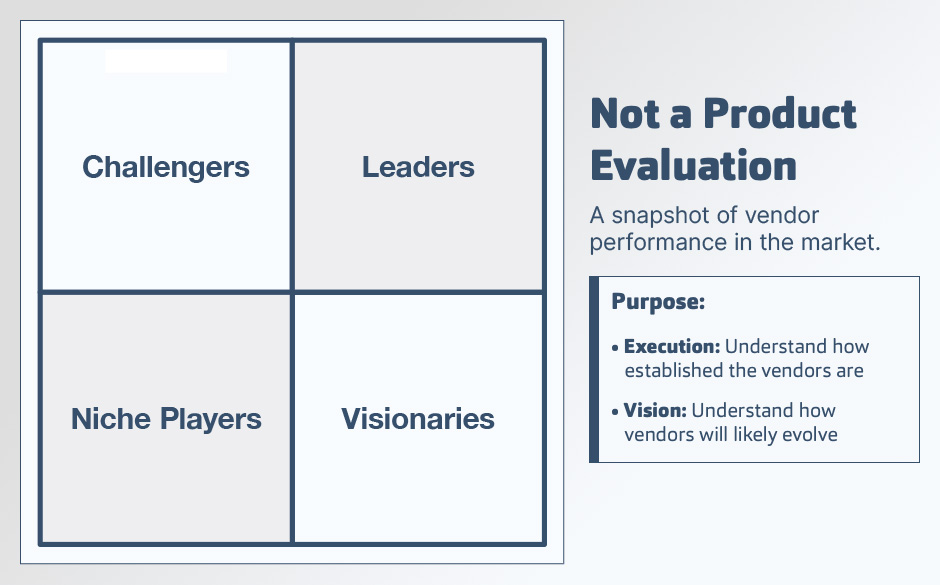
The graphic above summarizes it well.
The Gartner Magic Quadrant isn’t intended to answer “Which ITSM product is the best?” It’s simply intended to provide a snapshot of vendor performance in a market, so you know they’ll remain viable and performant in the future.
It’s valuable information.
Enterprise software purchases are long-term relationships. You’re buying far more than today’s feature list. You’re buying into a company’s ability to continue investing, supporting customers, executing successfully, and evolving with the market over the next five or ten years.
These things matter. But they still don’t tell you which product is the best fit for your organization. That’s a different evaluation.
How to Buy Software (Based on Gartner)
You’ve used the Magic Quadrant to figure out the biggest global players. Once you’ve identified vendors worth considering, the buying process changes. You’re no longer asking “Which vendor appears strongest in the market?”, so it’s time to move on to the next step. Now, you’re hopefully asking:
“Which product best solves my organization’s problems?”
For Gartner subscribers, this is where the next document becomes far more important than the Gartner Magic Quadrant itself: Gartner’s companion research note, Gartner Critical Capabilities. While the Gartner Magic Quadrant evaluates vendors, the Gartner Critical Capabilities report evaluates products.
The Gartner Critical Capabilities document scores products on individual capabilities and then evaluates them across multiple customer use cases (often 3-5).
The intent of the various use cases is to show the most common buying profile – a reason someone is buying. These profiles intend to give you, the buyer, an example of what a buyer might prioritize and why. And based on these priorities, Gartner provides a dedicated stack ranking of the solutions that are the best fit for that use case.
The “best solution” will be different for each buyer, as it depends entirely on your business.
Access Gartner’s Online Critical Capabilities
In addition to the example use cases, Gartner also gives dynamic access to the priorities and rankings in their online Gartner Critical Capabilities tool, enabling Gartner subscribers to create their own use case (reflecting their own buyer profile), set their own priorities, and see the product ranking Gartner recommends, customized to suit their specific use case.
So think about your priorities before buying:
- What problems are you trying to solve?
- What capabilities matter most?
- Where are the biggest operational gaps?
- What initiatives are strategic priorities over the next several years?
These answers vary from organization to organization.
The Magic Quadrant Is Only One of the Five Steps in Gartner BuySmart
One misconception I frequently see is organizations believing the Magic Quadrant is Gartner’s buying methodology.
It isn’t. It’s only one piece of a much larger process. So far, I’ve shared the Gartner Magic Quadrant and Critical Capabilities documents. However, these are still only ONE step in a FIVE-step buying process that Gartner recommends.
Gartner calls their 5-step buying process “Gartner BuySmart.”
The Magic Quadrant helps you understand the competitive landscape. The Critical Capabilities report helps you understand which products appear to best fit your priorities. Neither tells you what you should ultimately purchase. These reports just help you build a shortlist.
That’s it.
From there, Gartner’s BuySmart methodology expands into the rest of the procurement process.
- You still need to align stakeholders around priorities.
- You need to validate your business requirements. Then you need to confirm that vendors actually support these requirements during demonstrations (RFI/RFP).
- You’ll likely conduct proofs-of-concept. You’ll evaluate implementation risk. You’ll negotiate commercial terms. You’ll estimate expected return on investment (ROI).
Only then do you have enough information to confidently make a purchasing decision.
The Gartner Magic Quadrant/Critical Capabilities research gets you to the shortlist, and the rest of the Gartner BuySmart buying process gets you to the right decision and closes the deal.
What If You Aren’t a Gartner Client?
Not everyone has access to Gartner Critical Capabilities or Gartner’s BuySmart services.
This doesn’t mean you can’t follow the same thought process.
The Gartner Magic Quadrant remains an excellent place to start because it provides a high-level view of the competitive landscape. (Most participating vendors, including EasyVista, provide the report as a free download under Gartner’s licensed reprint program – EasyVista offers the Gartner Magic Quadrant for ITSM Platforms for free here!)
Use it to identify ITSM platform vendors worth evaluating.
From there, build your own structured evaluation:
- List the capabilities that matter most to your organization.
- Assign weightings based on your own priorities.
- Score each vendor against those requirements (likely based on RFI/RFP responses).
- Validate your findings through demonstrations, proofs-of-concept, customer references, peer review sites, and conversations with your own stakeholders.
This is basically how you recreate the same methodology Gartner uses to make sure your big enterprise software purchase is done right.
Final Thoughts
The Gartner Magic Quadrant is one of the most valuable pieces of technology research available to enterprise buyers, if used correctly. Unfortunately, it’s usually not.
It was never designed to answer “Which ITSM product should I buy?” and point you to the biggest honcho at the top-right corner. Instead, it answers “Which vendors appear to be performing well today and best positioned for tomorrow?”
That’s an incredibly valuable question. It gives you a sense of vendor viability. It’s just not the only question (not really even the PRIMARY question) before you buy a product.
The best purchasing decisions separate vendor evaluation from product evaluation:
- Use the Gartner Magic Quadrant to understand the market and vendor viability.
- Use Gartner Critical Capabilities, or your own structured evaluation framework, to determine which products best fit your organization’s needs.
- Follow a disciplined procurement process to validate your assumptions before signing a contract.
That’s much closer to how Gartner intends buyers to use the research. And in my experience, it’s also how organizations make significantly better software buying decisions.
Ranking Methodology: The vertical axis loosely reflects market scale using publicly available information. The horizontal axis reflects my subjective opinion of the shape and style of their logo. It’s my view that the shape and style of their logo are symbolic proxies for their visionary prowess. One axis describes the companies’ execution. The other describes my personal preference. That’s intentional. The result is an opinion-based snapshot of the market. The entire point is that being a market leader doesn’t automatically make a vendor’s product(s) the best choice for everyone.
Disclaimer: This graphic was created by Keith Andes at EasyVista as an educational editorial ranking to illustrate how the Gartner Magic Quadrant should be interpreted. Vertical placement loosely reflects publicly available market scale information. Horizontal placement reflects the author’s subjective opinion. It is not a formal evaluation of the fast-food industry or a recommendation for or against any company or product. EasyVista is not affiliated with or endorsed by any company shown. All trademarks are the property of their respective owners.
Gartner Magic Quadrant FAQs
It’s a research report from Gartner that evaluates how vendors are performing relative to one another in a given market, such as ITSM, at a specific point in time. It isn’t a product evaluation.
Two things: Ability to Execute, which reflects current market performance such as revenue, customer support, and implementation delivery, and Completeness of Vision, which reflects Gartner’s confidence in a vendor’s future direction and strategy. Neither axis measures product quality.
No. Keith Andes compares it to McDonald’s being the market leader in fast food: strong overall business performance doesn’t mean it’s the best choice for every individual buyer. The Magic Quadrant answers “how are these vendors performing against each other,” not “which product is best for me.”
The Magic Quadrant evaluates vendors. Critical Capabilities evaluates products, scoring them against specific use cases and enabling Gartner subscribers to build a ranking tailored to their priorities.
It’s Gartner’s five-step buying process, of which the Magic Quadrant and Critical Capabilities are just one step. The remaining steps cover aligning stakeholders, validating requirements, running demonstrations and proofs-of-concept, evaluating implementation risk, and negotiating terms.
Yes. Many vendors evaluated in the report, including EasyVista for the ITSM Platforms version, are permitted to license and share it, so it can be downloaded for free from participating vendors’ websites.
List the capabilities that matter most to your organization, assign your own weightings, score each vendor against these requirements, and validate the findings through demonstrations, proofs-of-concept, customer references, and peer review sites.

Keith Andes
Keith builds product marketing functions where market intelligence drives the strategy. From customer insights to competitive intelligence to analyst relations, he focuses on collecting the right inputs to make sure every decision (from messaging to go-to-market strategy) is rooted in clarity and confidence, reasoning from First Principles.

One Response
Really good post reframing the actual buying process businesses should use. The Gartner Magic Quadrant blog posts are the most read on the Starsight website, precisely because there’s a lot of confusion on the market.