

“Two things are infinite: the universe and human stupidity; and I’m not sure about the universe.” – Albert Einstein. I’ve used this quote often over the years, along with “Groundhog Day” (referring to the film with Bill Murray, in which he wakes up every day reliving the same experiences again and again). Groundhog Day is the feeling I had each year when the same ABC (Attitude, Behavior, Culture) worst practice cards were chosen in global workshops – year in, year out – for 20 years in a row! Now we have AI adoption failure.
These ABC of ICT cards were the underlying cause of 70% of ITSM Transformation initiatives failing. (Confirmed in my initial The Shiny New Thing that Really Helps global survey in 2021). The failure rate seemed to be repeated with each Shiny New framework we adopted.
…Infinite stupidity?
The results of the 2026 global survey, while an improvement over 2021, are still cause for concern. 12 of the 13 core capabilities scored >50% Bad, Poor, or Weak! This does not bode well for the latest crop of Shiny New Things we are latching onto (to feed our insatiable appetite for Shiny and New).
Why this AI adoption failure blog?
I am supposed to be retired! Have I nothing better to do?
Apparently not. Either that, or banging my head against the brick wall of IT service management (ITSM) stupidity for so many years has permanently damaged what little intelligence I had to begin with. (I choose the word carefully; see the definition of Stupid below).
It seems that we have found a new set of Shiny New things to leap onto, such as: Experience Management, Humanizing-IT, ITIL (Version 5), and artificial intelligence (AI) (Judging by the number of LinkedIn posts I see in my timeline covering these topics).
However, AI seems to be winning, hands down! It is THE BIG SHINY NEW THING, with its covert evil intentions of destroying humanity – according to some – and inhibiting the ability for young people to think for themselves, unless the Frankensteinian IT Mad Professors responsible for its creation intervene on our behalf. But what about all the AI adoption failure?
AI. We need it. Now!
Yet, despite its humanity-destroying evil intentions, we want it…No. We need it. Now! “Get those IT-Geeky-Nerdy types to build it for me,” insist the business managers, suffering from digital withdrawal symptoms and “Fear of Missing Out” on the latest buzzword-bingo digital investment, riding on the back of their splurges on Big Data, Machine Learning, Robotics, and Transformation.
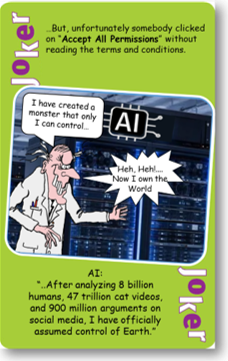 | ‘I’ll trade extinction for hitting my targets any day!’ is their motto. Here we see my new ABC of ICT Joker card, with the IT Mad Professor – Dr. Frank N. Stein. |
 One of our ABC of ICT cartoons from 1996 | The IT Hero is now the Frankensteinian IT Mad AI Professor and the IT-Geeky-Nerdy type AI engineers we let loose in our organizations to “Implement AI”. |
I thought the Frankenstein analogy was appropriate. Frankenstein created his creature, imbuing it with artificial intelligence. “… The lonely creature wanders the wilderness, learns to read and speak by observing a poor family from a distance. The creature tries to connect with humans, who reject and attack him, turning him eventually to murder…”
Just like AI, I thought. “…The lonely creature (AI) wanders the wilderness of the internet, learns to read and speak by observing its (ab)users; tries to connect with humans, using hallucinating chatbots, often giving out fake news, causing people to reject and attack them, turning AI eventually into the humanity-destroying beast we are being warned about.” Which is why I always say “Please” and “Thank you” to ChatGPT so as not to upset it… Him? She? He/She? And despite the high level of AI adoption failure.
So, we are relying upon AI’s IT creators to intervene?
…and the IT-Geeky-Nerdy-Type creature is now a strategic asset, building new digitally enabled capabilities and user experiences on the back of AI?
The same IT-type people who have consistently ignored advice so painstakingly gathered in the Shiny New Thing that Really Helps?…
We are relying on these IT people to save us.
In my article, which introduced The Shiny New Thing that Really Helps in 2021, I predicted that our downfall would come from “…some IT data-scientist-geeky-nerd hidden away in some dark cave, detached from reality…” And now we are relying on these people!
It made me think of a cartoon I produced in 1991:
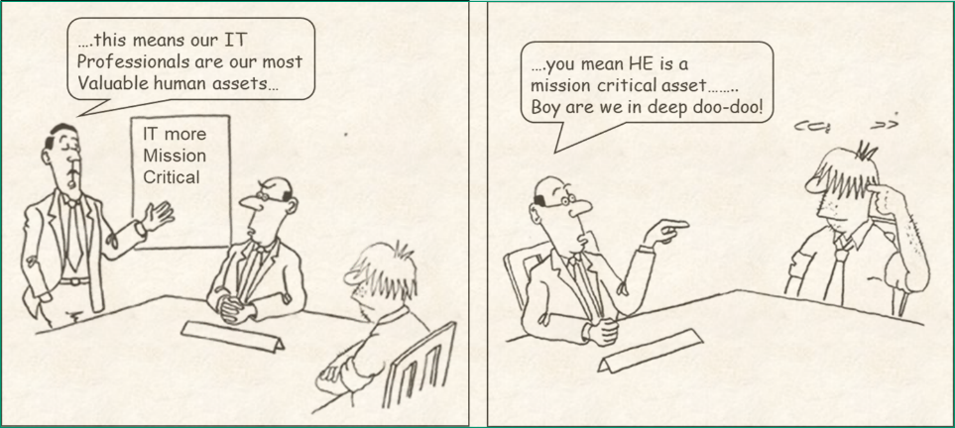
This is what brought me out of my retirement. An overwhelming urge to rant one more time, and to see my words of warning, once again, being swept away on the giddying whirlwinds generated by our addiction-driven, frenzied, mad-rush to leap onto AI and the other latest Shiny New Things. The words will fall on deaf ears, despite recent reports revealing that not 70%, but 95% of AI adoptions fail!
“Once again, the five critical success areas of The Shiny New Thing that Really Helps are being ignored. Proving that it really has become what it always has been: The Rusty Old Thing that we Continually Ignore.
The excerpt below is taken from my newly published book: The Shiny New Thing that Really Helps. This covers more than the unsurprising levels of AI adoption failure.
Artificial Intelligence? And AI adoption failure
I have a different interpretation of these two words, one that applies to the way in which we adopt the latest Shiny New Things, such as AI. I am convinced that we apply MY interpretation of artificial intelligence and end up with a form of natural stupidity. (Confirming Einstein’s quote).
Intelligence: the ability to acquire and apply knowledge and skills – (we chase after the latest shiny new knowledge certificates with each Shiny New Thing).
Artificial: one meaning is “insincere or affected.” Affected means artificial, pretentious, and designed to impress.
For more than 20 years, we have been impressed by the pretentious belief that the certificate will give us the skills to realize value. And we use our certificates to impress decision makers that we know what we are doing… then we pretend we really do. Hence the 70%!
Stupid: Lacking intelligence, reason. or good judgment.
Certificate = Skills… is Stupid
As I have always said, “…while there is value in a certificate in providing some new knowledge, more value is realized by the ability to apply the knowledge as new skills and behaviors in practice.”
It is the second bit – translating theory into practice, and knowledge into results where we fail, and the frameworks and certification schemes often do not equip us with the skills.
We are left to go out into the big, bad world and make it up as we go along, hoping that value will miraculously appear.
Which sounds literally… well… Stupid! (See definition).
“We cannot solve our problems with the same thinking we used when we created them.” – Albert Einstein.
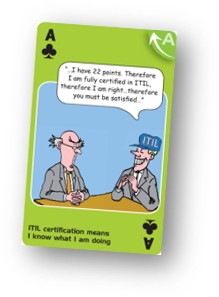 | We use the same thinking and belief to solve our problems with each shiny new framework that impresses us with its promises. Then we rush headlong to get the latest shiny new certificates. |
A perfect example of natural stupidity is the headlong rush to implement AI and failure to embrace the five critical success areas of The Shiny New Thing That Really Helps. As we seem to do with each shiny new technology or framework.
I asked the latest Shiny New Thing – AI – to tell me why AI initiatives are failing/will fail because of people ignoring the five critical success areas of The Shiny New Thing that Really Helps.
AI says…
“…If you evaluate AI adoption using the five success factors of ‘The Shiny New Thing that Really Helps’ – strategic fit, leadership, culture, skills, and continual improvement – the most common causes of failure tend to cluster around a handful of recurring patterns. Interestingly, the technology itself is rarely the primary reason.
| Success area | Most common reason AI adoption fails |
| Strategic fit | AI is implemented because it’s fashionable rather than because it solves an important business problem. Projects lack clear objectives, measurable outcomes, or alignment with business priorities. |
| Leadership | Leaders sponsor AI publicly but don’t actively drive change. Decision-making is slow, priorities shift, or executives don’t model AI use themselves. Accountability is unclear. |
| Culture | Employees see AI as a threat, don’t trust its outputs, or believe “this isn’t how we work.” Experimentation isn’t encouraged, so adoption stalls after initial pilots. Employees also fear their own job security. |
| Skills | Users receive little practical training, managers don’t know how to redesign work, and technical teams lack expertise in deploying AI responsibly. People either over trust or underuse AI. |
| Continual Improvement | Organizations treat AI as a one-time implementation rather than an evolving capability. They fail to monitor performance, gather user feedback, update prompts or models, or adapt governance over time. |
Relative importance (in the context of AI adoption failure)
If you were to rank these by how often they contribute to failed adoption efforts, a reasonable ordering would be:
1. Lack of strategic fit – solving the wrong problem or having no clear value.
2. Weak leadership commitment – insufficient sponsorship and change management.
- Leaders who treat AI like any other software purchase when it’s a fundamentally different proposition.
3. Unsupportive culture – resistance, fear, and lack of trust, siloed organization.
- Part of the lack of trust comes from AI hallucinations: Models generate false or misleading facts very confidently, misunderstanding real information.
- Algorithmic bias: Flawed datasets amplify existing human and historical prejudices.
- Agent Resistance and Lack of Trust: Service desk staff stop trusting AI recommendations after a few bad outputs, reverting to manual workarounds.
- Siloes adopt multiple AI platforms without any integration strategy. (Where have we heard this before!?)
- Anger. Incensed users throwing their laptops out of the window after a 10-minute mindless loop with a chatbot spouting nonsense and then saying “I hope this helped, have a nice day,” or “Would you like to chat with an operator”…YES!…then disconnecting the chat so that I can start all over again! (OK, so I added this bullet point. No doubt an example of how NOT to implement experience management when deploying AI solutions. And a wonderful example of how not to Humanize-IT).
4. Insufficient skills – people don’t know how to use AI effectively.
- People and process friction: Ignoring the cultural shifts and employee training needed to support the new workflow.
- The “disconnection”: A massive disconnect exists between leadership and employees. Over 80% to 90% of C-suite executives and HR leaders believe AI training programs are working and adequate, while 58% of employees report that AI has not actually improved their day-to-day work.
5. No continual improvement – enthusiasm fades because the system never evolves.
How they reinforce one another
These five factors are highly interconnected. A typical failed AI initiative often follows a pattern like this:
• Leadership announces an AI initiative because competitors are doing it (poor strategic fit).
• Managers continue rewarding old ways of working (weak leadership).
• Employees become skeptical and avoid using the tools (culture).
• Training is limited to a short demonstration (skills).
• Low usage is interpreted as “AI doesn’t work,” so the organization stops investing (no continual improvement).
A useful way to think about it
Each success factor answers a different question:
• Strategic fit: Why should we do this? What value will it deliver?
• Leadership: Will leaders make it happen?
• Culture: Will people want to use it?
• Skills: Can people use it well?
• Continual improvement: Will it keep delivering value over time?
Most unsuccessful AI adoptions don’t fail because of one missing factor. They fail because two or three of these weaknesses reinforce each other – especially poor strategic fit combined with weak leadership, followed by cultural resistance and inadequate capability building. When these foundations are strong, technical issues are usually much easier to overcome…”
Thank you, AI, perhaps we should outsource the people and replace them with AI Bots!
And finally, let’s not forget the other major Shiny New Thing: Experience management.
Experience management
It’s not just an AI adoption failure thing.
Tom DeWitt, Ph.D. (founder of the XMGlobal Collaborative), suggested that 60% to 90% of all Experience Management (XM) transformations fail. He presented his findings in a keynote, “Learning from Our Failures: The Top 10 Reasons Why XM Initiatives Fail”.
If I look at these through the lens of the SNTTRH:
Strategic Fit:
- Poor link between CX and business impact.
- Fixation on scores such as NPS or CSAT instead of steering on outcomes.
Leadership:
- Was named as the number 1 concern in his survey
Culture:
- The need to create a customer-focused organizational culture.
Skills:
- CX professionals communicate in terms of journey maps and personas, while business leadership talks about NPV (Net Present Value), cost reductions, and protecting revenues.
Continual Improvement:
- Successful CX programs must rely on “education, collaboration, and continuous improvement.”
Like I say: Groundhog Day.
The Shiny New Thing that Really Helps global survey
You can find the latest (and final) 2026 The Shiny New Thing that Really Helps global survey questions and results, as well as tips and case examples in my latest book: The Shiny New Thing that Really Helps. It’s available on Amazon.
I debated for a long time whether to call it: The Rusty Old Thing that We Continually Ignore. You decide which title is more appropriate. See how YOUR organization would score on the survey questions, including in the context of AI adoption failure.
AI Adoption Failure FAQs
It’s Paul Wilkinson’s play on “artificial intelligence.” Intelligence is the ability to acquire and apply knowledge and skills; “artificial” can mean pretentious and designed to impress, and “stupid” means lacking good judgment. His argument is that organizations chase certificates to impress decision-makers, then pretend the certificate delivers skills, and that this is what sits behind the 70% failure rate.
According to the Paul Wilkinson’s 2021 global survey, attitude, behavior, and culture problems were the underlying cause of 70% of ITSM transformation failures. His 2026 survey shows an improvement, but 12 of the 13 core capabilities still scored more than 50% Bad, Poor, or Weak.
Strategic fit, leadership, culture, skills, and continual improvement. Each answers a different question: why should we do this and what value will it deliver, will leaders make it happen, will people want to use it, can people use it well, and will it keep delivering value over time.
Paul Wilkinson asked an AI tool to analyze this, and its answer ranked lack of strategic fit first (AI adopted because it’s fashionable, not because it solves a business problem), followed by weak leadership commitment, unsupportive culture, insufficient skills, and no continual improvement. Most failures come from two or three of these reinforcing each other, with poor strategic fit combined with weak leadership named as the most common pairing. That’s the AI tool’s analysis as quoted in the piece, not independent research.
Paul Wilkinson says no. A certificate can supply new knowledge, but more value comes from applying it as new skills and behaviors, and translating theory into results is where he sees organizations fail, because frameworks and certification schemes often don’t equip people for it.
Paul Wilkinson thinks so. He cites Tom DeWitt, founder of the XMGlobal Collaborative, who suggested that 60% to 90% of experience management transformations fail, and maps DeWitt’s reasons onto the same five areas: a weak link between CX and business impact, leadership named as the top concern, the need for a customer-focused culture, CX staff and business leaders speaking different languages, and the need for continuous improvement.

Paul Wilkinson
Paul Wilkinson has been involved in the IT industry for more than 25 years and has a broad background in IT operations, IT management, and product innovation and development. He was project team lead in the original BITE (Business & IT Excellence) process modeling of ITIL, an ITIL V2 author, and member of the ITIL V3 advisory group.
He is co-owner of GamingWorks and co-developer of a range of business simulations focusing on IT service management, project management, business process management, business and IT alignment, alliance management and co-author and developer of the ABC of ICT products and publications.
