
ITIL (Version 5) is here, and many questions are being asked. This article answers some of the most frequently asked questions. Of course, if you have more questions, feel free to reach out to me or to post them below.
Let’s start with why ITIL has changed.
Why ITIL (Version 5) Was Introduced
Six Years is a Long Time in IT
The world of business and IT’s role in it has changed significantly since ITIL 4 was published in 2019. We’ve seen:
- Fast-growing complexity
- Emergence and fast adoption of AI
- Balance between strategic direction and practicality
- Persistent silos within the technology industry
- Growing attention to the human side of technology.
Addressing Complexity, AI, and the Human Side of Technology
These and other changes mandated a revised or updated version of ITIL. This included:
- For the fast-growing complexity – a complexity-native framework
- For the emergence and fast adoption of AI – AI-native guidance
- For the balance between strategic direction and practicality –
clear positioning for leaders, managers, and practitioners - For the persistent silos within the technology industry – an integrated framework for digital product and service management
- For the growing attention to the human side of technology – a comprehensive practical guidance for experience improvement.
What’s New in ITIL (Version 5)? Key Changes at a Glance
In terms of what’s changed, the key differences in ITIL (Version 5) are that:
- There’s a new ITIL Product and Service Lifecycle, which unifies digital product and service management in one model
- The ITIL Value System is strengthened with a clearer, modular value chain model
- There’s a better end-to-end, experience-driven understanding of how value is created
- The Value System aligns value chain activities with governance, guiding principles, practices and continual improvement.
- There is a new Transformation model (and a dedicated book) helping to make sustainable organizational changes
- There is a dedicated publication on Experience and experience optimisation
- There is a new Strategy Management model helping to develop and implement digital strategy in the VUCA world (Volatility, Uncertainty, Complexity, and Ambiguity).
The ITIL Value System
The updated ITIL Value System, the central model of ITIL (Version 5), is shown below.
The ITIL Value System
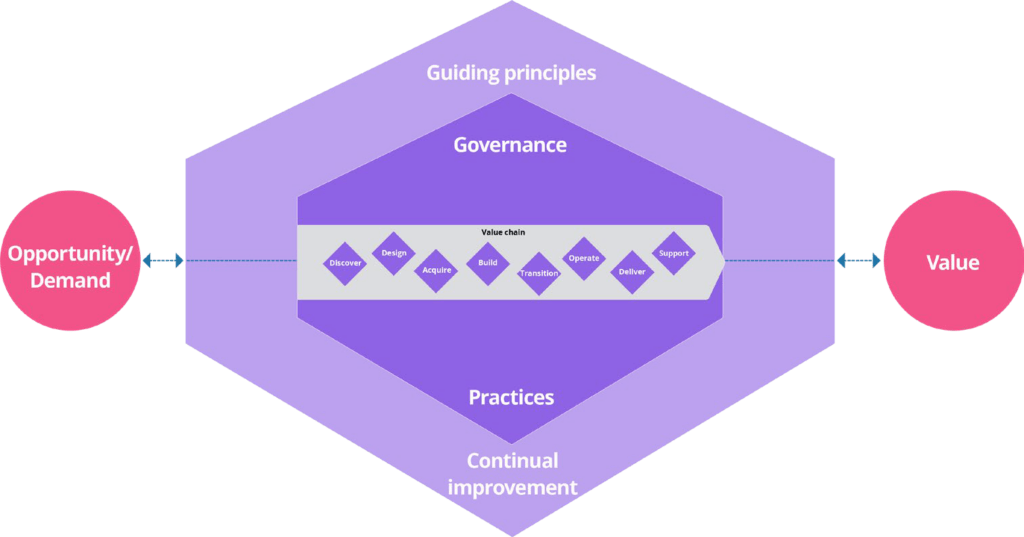
Source: PeopleCert, ITIL Foundation Version 5 Edition
The new ITIL (Version 5) publications build on the above, as described below.
New ITIL 5 Publications and Practice Areas
Product and Service Management
Digital products and services are two sides of one solution. Organizations need to understand and manage the full lifecycle with clarity and confidence.
The new ITIL Product and ITIL Service publications provide a detailed description of the eight value chain activities from the two perspectives: Product vendor and Service provider.
Experience Management
User and customer experience are increasingly important for value co-creation. Employee experience is a predictor of consumer experience.
The new ITIL Experience publication details the service journey
- From an organizational perspective
- From the individual roles’ perspective
- Mapped to the new value chain.
There’s practical guidance on capturing, assessing, and improving experience in this ITIL (Version 5) publication.
Strategy in a VUCA World
Strategy needs to be adjusted for growing VUCA .
The ITIL Strategy publication is a practical guide to planning and implementation. There’s a new strategy planning and implementation model that’s:
- Optimised for complexity
- Actionable, step-by-step guidance
- Tailorable and integrated with the transformation model
There’s also a supporting toolbox of strategic capabilities.
AI Governance
PeopleCert has also created an ITIL AI Governance publication. While this ITIL (Version 5) content isn’t part of the “core” ITIL body of product and service management best-practice guidance, it offers invaluable help for organizations facing one of the key ITSM challenges today.
This will be covered in more detail in a later ITSM.tools article.
Transforming Successfully
Organizations’ transformation efforts often fail. Existing frameworks were created for a predictable, clear environment (which does not exist).
The ITIL Transformation publication provides:
- A new complexity-driven transformation model
- Step-by-step contextual guidance
- Governance, initiation, and execution patterns
- A toolbox of supporting methods and techniques.
What’s Next for ITIL Management Practices in ITIL (Version 5)?
The ITIL 4 management practice publications are currently unchanged but will be updated for ITIL (Version 5) in H2 2026. This includes:
- Terminology alignment (all practices)
- Addition of established AI use (selected practices)
- Additional product focus (selected practices).
Want to Learn More About ITIL (Version 5)?
If you want to learn more about the changes in ITIL (Version 5), feel free to reach out to me on LinkedIn or look out for the many in-person and virtual sessions my PeopleCert colleagues and I will be participating in during 2026.
ITIL (Version 5) FAQs
ITIL (Version 5) is the latest evolution of the ITIL framework for digital product and service management. It builds on ITIL 4 by introducing new guidance for managing complexity, AI, transformation, strategy, products, services, and experience management.
ITIL (Version 5) was introduced to address significant changes in the business and technology landscape since ITIL 4 was published in 2019. These changes include increased complexity, rapid AI adoption, growing emphasis on customer and employee experience, and the need for more practical guidance on transformation and strategy.
The biggest differences include:
A new Product and Service Lifecycle
A strengthened ITIL Value System
Dedicated publications for Product, Service, Experience, Strategy, and Transformation
AI-native guidance and governance concepts
Greater focus on experience management and value co-creation
Enhanced support for managing complexity and organizational change.
Yes. ITIL (Version 5) is the next evolution of the framework. However, many of the core concepts from ITIL 4 remain, including the guiding principles, continual improvement, governance concepts, and management practices.
The ITIL Product and Service Lifecycle is a new model that unifies digital product management and service management. It helps organizations understand how products and services are planned, developed, delivered, supported, and improved throughout their lifecycle.
The ITIL Value System remains the central model of the framework. In ITIL (Version 5), it has been strengthened with a clearer and more modular value chain approach that connects governance, guiding principles, value chain activities, management practices, and continual improvement.
The ITIL Experience publication focuses on understanding, measuring, and improving customer, user, and employee experiences. It provides practical guidance for mapping service journeys, identifying pain points, and enhancing value creation through better experiences.
ITIL (Version 5) recognizes that customer, user, and employee experiences are critical to value co-creation. Research increasingly shows that employee experience influences customer experience, making experience management a key capability for modern organizations.
The ITIL Strategy publication provides practical guidance for developing and implementing digital strategies in environments characterized by volatility, uncertainty, complexity, and ambiguity (VUCA). It includes a new strategy model, implementation guidance, and supporting strategic tools.
VUCA stands for:
Volatility
Uncertainty
Complexity
Ambiguity
The term is used to describe the challenging and rapidly changing environments in which many organizations now operate.
The ITIL Transformation publication introduces a complexity-driven transformation model designed to help organizations successfully manage change. It includes governance guidance, execution patterns, transformation techniques, and practical tools to support sustainable improvements.
Many transformation initiatives fail because they rely on approaches designed for predictable environments. ITIL (Version 5) acknowledges the realities of modern organizations and provides practical guidance for leading change in complex and uncertain conditions.
ITIL AI Governance is a dedicated publication that helps organizations manage AI responsibly and effectively. It provides guidance on governance, oversight, risk management, ethical considerations, and the use of AI within digital products and services.
AI Governance complements the core ITIL (Version 5) body of knowledge. While it sits alongside the main product and service management publications, it addresses one of the most important emerging challenges facing organizations today.
The ITIL management practice publications remain largely unchanged initially. However, updates are planned for the second half of 2026 to align terminology with ITIL (Version 5), incorporate established AI use cases, and increase product-focused guidance where appropriate.
No. ITIL (Version 5) builds upon the foundations established in previous versions. Existing ITIL practitioners will find many familiar concepts while gaining additional guidance on products, services, AI, strategy, transformation, and experience management.
ITIL (Version 5) is relevant for:
IT service management professionals
Product managers
Service managers
Digital transformation leaders
IT leaders and executives
Customer experience professionals
Governance and risk professionals
Anyone involved in creating, delivering, supporting, or improving digital products and services.
Organizations adopting ITIL (Version 5) can benefit from:
Better alignment between products and services
Improved customer and employee experiences
More effective AI governance
Stronger transformation capabilities
Better strategic planning in complex environments
Enhanced value creation and business outcomes.
You can follow PeopleCert announcements, attend ITSM industry events, participate in webinars, and connect with ITIL experts and trainers who share insights into the framework’s evolution and practical application. ITSM.tools will, of course, continue to share ITIL-related information and guidance.
Further Reading

Roman Jouravlev
Roman is an ITSM Portfolio Development Manager, responsible for the ITIL continual development. He joined AXELOS in 2016 after working for more than 15 years in ITSM, mostly in Russia, as a trainer, consultant, quality manager, and service desk manager.
Roman has authored and translated several books and many articles on IT management. An ITIL v2 Service Manager and ITIL Expert, he has delivered nearly every ITIL certification training available since 2002.