
How would you rate your organization’s IT service management (ITSM) or ITIL-adoption success? Not just in terms of process or practice adoption, but in serving your parent business. The last ITSM benchmarking results I read were published by Axelos in 2022, which might have been because I was involved in creating the ITSM-focused benchmarking survey and report.
We saw some interesting insights back then, but I’m not sure where to look for anything newer right now. Well, that is, until I learned about the PeopleCert ITIL Performance Benchmarking Model. There’s more on this later. But first, here’s where we were four years ago.
2022 Data
The Axelos 2022 ITSM Benchmarking Report identified the adoption levels of some “core” ITSM capabilities (using the ITIL 4 practice names) and captured self-declared ratings of success. The table below shows the results for “Working well” and “Needs improving.”
These latter two percentages have been increased to reflect each capability’s adoption level. For example, the reported “Working well” level for asset management was 33%, while the adoption level was 89%; this equates to 37% of 89%.
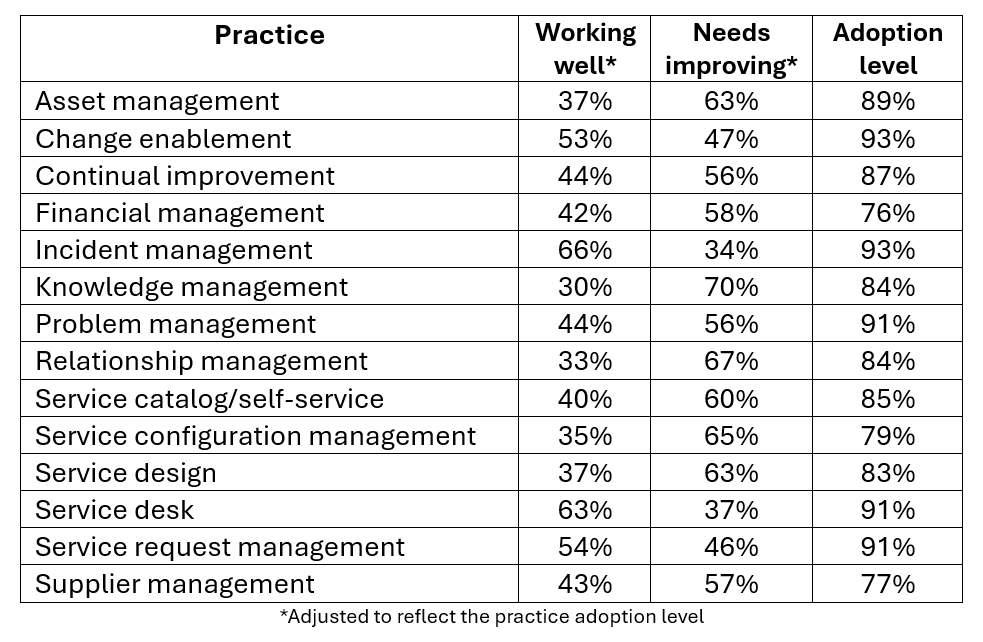
Source: Axelos, ITSM Benchmarking Report 2022
You’ll notice that there was quite a range of percentages in these benchmarking results. For example, incident management – as expected – had the highest adoption level and the highest “Working well” level.
However, and knowledge management was a good example, some ITSM capabilities were widely adopted but had a low “Working well” percentage.
The Axelos survey data was a great snapshot in time. It showed not only what was being adopted but also which ITSM capabilities organizations still struggled with. However, it was also potentially subjective and internally focused.
Why the ITSM Benchmarking Data Was Potentially Subjective and Internally Focused
The self-rating survey didn’t offer a framework or method for assessment. It was a simple rating of each ITSM capability on a scale from “Not needed” to “Working well.” So, there was no guarantee that the self-ratings provided were consistent.
For example, a respondent from one organization might have rated an ITSM capability as “Working well.” In contrast, another organization might have rated a similar level of capability as “Needs improving” based on its own perceptions of what’s needed.
In terms of being internally focused, the survey asked about what is being done rather than about what is achieved (through it). It focused on operations rather than outcomes (although each respondent might have taken their own perspective when self-rating).
So, while this benchmarking data is helpful, the level of subjectivity, in particular, is unknown.
Taking Some of the Subjectivity Out of ITSM Benchmarking
Surveys can be easily modified to shift questioning from operations to outcomes. However, there will likely always be some level of subjectivity in ITSM benchmarking.
For example, personal perceptions of whether an ITSM capability is adequately executed might differ. Plus, given that ITIL takes an “adopt and adapt” approach, different organizations will have different needs from the body of service management best practice.
For example, hearing a peer say they “use ITIL” could mean anything from adopting a small part of a single ITIL practice to fully using multiple ITIL practices. So, more can be done to reduce the subjectivity evident in the above dataset by providing a consistent evaluation framework.
The first time I’ve seen this, perhaps outside of what industry analyst firms such as Gartner collect using process-focused maturity models, is a new PeopleCert offering. It covers far more than the ITIL practices, as shown in the examples below.
Hopefully, this new facility can now give your organization greater insight into how far it has come and how much more it needs to do in delivering digital products and services.
PeopleCert’s New ITSM Benchmarking Facility
I like to think most people want every organization to succeed with digital product and service delivery (including ITIL alignment). However, on the flip side, it can be difficult to understand how well your organization is doing at establishing the right capabilities, despite the investment in ITIL training and ITSM tooling.
To help, PeopleCert has created an ITIL Performance Benchmarking Model that allows organizations to better understand how what they have done, and are still doing, helps to support business performance. Helped by defined ways for calculating key metrics.
It’s described as:
“… a structured way for organizations to assess how effectively they use and manage digital technology, using a focused set of benchmark-ready metrics to compare performance with industry peers.”
Performance Benchmarking Examples
The PeopleCert ITIL Performance Benchmarking Model covers far more than the practices. Asking about areas such as:
- Management satisfaction with how digital technology enables the business
- SLA compliance rate
- Management satisfaction with solution delivery.
With the method of calculation suggested for each.
Some “traditional” metrics are included as well. For example, the incident rate, where the following guidance is given:
“Calculate by using the formula below:
Value = (Number of incidents a month) / (Number of users)
In the numerator, please use the number of incidents in one fully completed month. It is important to count incidents only, excluding service requests or any other types of requests.
In the denominator, please use the average number of IT users for the same month. Only employees who are granted access to the company’s IT services should be included.
It’s recommended to select a month of normal business activity to avoid local spikes that do not reflect the company’s typical performance, or to calculate an average across two to three consecutive periods.
The expected value is the number, usually between 0.5 and 3.0 (for example, 1.8). Please leave the field empty if you can’t provide the value.”
And on-time incident resolution:
“Calculate by using the formula below:
Value = (Incidents resolved on time) / (Total number of incidents) * 100%
In the numerator, include the number of incidents that were successfully resolved during the assessment period within their agreed resolution targets.
In the denominator, include all incidents resolved during the same period.
It’s recommended to select a month of normal business activity to avoid local spikes that do not reflect the company’s typical performance, or to calculate an average across two to three consecutive periods.
The expected value is the percentage (for example, 89). Please leave the field empty if you can’t provide the value.”
ITIL Practice Maturity Self-assessment
As part of the ITIL Performance Benchmarking Model, there’s also a simple maturity self-assessment that allows the respondent to rate their maturity for 25 ITIL practices across:
- Initial (ad-hoc activities)
- Repeatable (well-established, automated)
- Defined (repeatable and well-documented)
- Measurable (defined and regularly measured)
- Improving (measurable and regularly improved).
This not only expands on the benchmarking for the 2022 survey and report, but also helps respondents select the right “answer” for each ITSM capability.
Get Involved and Benchmark Your IT Organization
If you would like your IT organization to participate in the initial ITIL Performance Benchmarking, PeopleCert is collecting baseline data over the next few months. Just visit this link to take part: https://forms.gle/Q6YLgYgZm4upx6b6A
In terms of the “What’s in it for me?”, if you take part in the first international ITIL Performance Benchmarking study, you’ll receive the full benchmarking report with insight into how your IT organization compares with industry peers.
Further Reading

Stephen Mann
Principal Analyst and Content Director at the ITSM-focused industry analyst firm ITSM.tools. Also an independent IT and IT service management marketing content creator, and a frequent blogger, writer, and presenter on the challenges and opportunities for IT service management professionals.
Previously held positions in IT research and analysis (at IT industry analyst firms Ovum and Forrester and the UK Post Office), IT service management consultancy, enterprise IT service desk and IT service management, IT asset management, innovation and creativity facilitation, project management, finance consultancy, internal audit, and product marketing for a SaaS IT service management technology vendor.