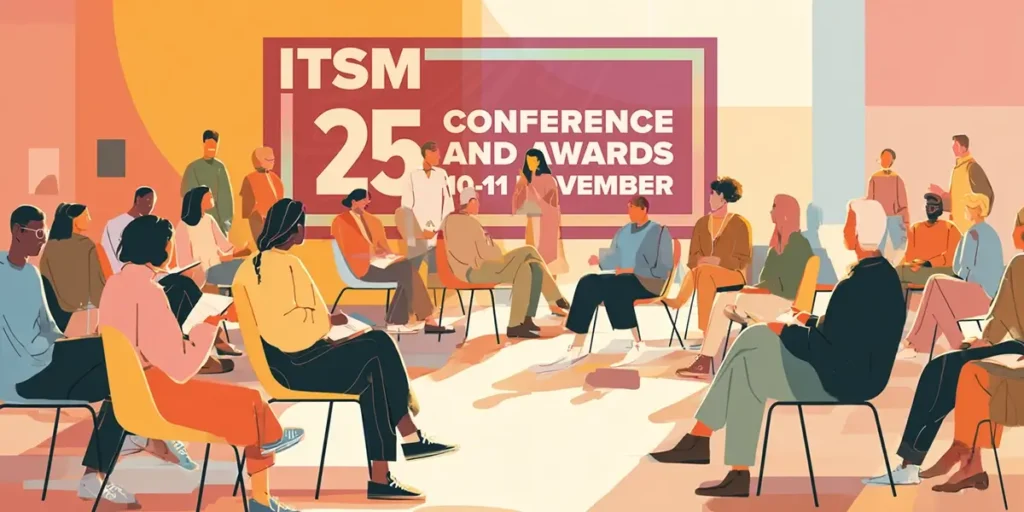
Earlier this month, I attended the itSMF UK 2025 (ITSM25) conference, and it was my first itSMF UK conference in a few years. The change in venue to Milton Keynes seemed to work very well (in my opinion, although I’m marginally biased by its close proximity to my home). The venue was easier to navigate, the atmosphere felt lighter, and the crowd seemed more diverse and – dare I say it – younger than at previous events I’d attended.
Most importantly, across both days, the conversations centered on people – not tools or frameworks, but how work actually happens day to day inside IT teams.
itSMF UK 2025 conference: Rethinking Service Through a Bookstore Lens with Roy Atkinson
One of the first itSMF UK 2025 conference breakout sessions I attended was Roy Atkinson’s. He discussed the Barnes & Noble story and how things changed once local teams had more input in shaping their own stores. It demonstrated the importance of trusting the people closest to the work and understanding the actual needs of the community you serve.
Roy linked this back to IT service management (ITSM) simply and practically: pay attention to how services are actually used, give teams the ability to make informed decisions, and look at what’s happening in real-life situations rather than the polished version of reality we sometimes imagine.
One downside to the session, perhaps, (and no reflection on Roy) was that many people in the room were hearing the phrase “outside in” for the first time, even after all these years of discussing it in ITSM. I think even Roy himself was surprised at having to pause to explain the difference between outside-in and inside-out.
itSMF UK 2025 conference: Seeing the Full Lifecycle with Roman Jouravlev
Next up for me at the itSMF UK 2025 conference was Roman Jouravlev‘s session. He spoke about how value only exists when both sides participate, and how giving someone access to a system isn’t enough to guarantee anything on its own.
He also explained how digital products and digital services share one lifecycle. When organizations focus solely on one stage, it leads to issues that emerge later, particularly in operations and support. His session encouraged people to look at the entire workflow instead of just the piece that falls within their own team.
itSMF UK 2025 conference: Understanding People Before Designing Solutions with Katrina Macdermid
Katrina Macdermid asked the room what the business thinks of IT, and the responses made it clear why her session was needed. She focused on the Double Diamond (from HIT Global) and why teams need proper time to understand a problem before trying to solve it.
She discussed the archetypes that appear in almost every organization and how designing with real behaviors in mind is far more effective than designing for an idealized user who doesn’t exist. People recognized these patterns instantly, which made the session easy to relate to.
itSMF UK 2025 conference: Neurodiversity, Real Adjustments, and Why This Matters with Faith Thomas
Faith Thomas delivered one of the most important sessions of the itSMF UK 2025 conference. She spoke openly about being a neurodiverse woman working in ITSM and demonstrated how her team at the University of Birmingham has developed ways of working that support diverse communication and thinking styles.
She shared examples such as breaking work into smaller parts, using retrospectives to learn rather than criticize, making it normal to ask for help, and working with natural variations in focus and energy. She also highlighted strengths that are often overlooked, such as visual thinking and pattern recognition.
This session meant a lot to me. Our oldest daughter is autistic, and she’s only ten, but school has been overwhelming for her because it expects one communication style and one pace. Many workplaces operate just like that. Universities appear to be further ahead, but there is still much more to be said and done in this arena, particularly in terms of both businesses and schools.
I’m glad Faith’s session was included, and I really hope more conferences follow suit. Not just with one breakout session, but multiple. The keynote stage! It’s such an important topic we need to be discussing.
itSMF UK 2025 conference: Why Transformations Slow Down with Barclay Rae and Steve Cave
Barclay Rae and Steve Cave focused on Target Operating Models, but the real topic was why transformation work often loses momentum. It’s rarely due to tooling; it usually comes down to people not being clear on how work is supposed to move, who makes which decisions, and what constitutes good work.
They emphasized the need to make work visible: mapping services, agreeing on roles and responsibilities, being clear about outcomes and behaviors, and keeping everything simple enough that it can be used across the organization rather than only by a small group of leaders.
What Could Be Improved for Next Year
The itSMF UK 2025 conference itself was strong, but I must be honest, the Awards Dinner was a bit challenging. The lighting was strange (I don’t know how else to describe the weird purple tone and flashing lights), and the volume was high enough that several people, especially those who are neurodivergent, had trouble staying in the room. I’m not neurodivergent, and I struggled.
I also felt that the awards themselves could have been more valuable. The introductions didn’t provide the audience with a clear sense of what the winners had achieved. It felt a little like buzzword bingo, and I left the room no more knowledgeable than when I entered it. It’s a shame because the conference itself really has improved and offered great value to delegates, but the Awards just felt a little difficult, if I’m honest. I also feel bad that I don’t have a real sense of what each of the winners achieved.
Mark Watson, arriving later in the evening, helped bring a breath of fresh air to the room. It would be great to see him return in the capacity he was intended (he was late due to being stuck in traffic).
I do want to extend a huge congratulations to Claire Agutter, though, for winning the Lifetime Achievement Award. I believe it’s the first time in over 10 years that it has been won by a woman, and I can’t think of a better woman in ITSM to have won it.
Final Thoughts
Milton Keynes worked well as a venue, and the itSMF UK 2025 conference sessions (that I attended) were genuinely valuable. The practical examples, the focus on full lifecycle thinking, the design approach, the human-centered focus, and especially the work on neurodiversity all provided people with something concrete to take back to the office. It’s been a while since I’ve attended an event where every session I attended was of good calibre.
My only caveat would be that there was a gap between what gets discussed during the day and how the Awards are run. If we’re going to have sessions about Neurodiversity on the agenda (and yes, please, we need more), then we also need to consider how those discussions apply to the conferences themselves, too.
Further Reading

Sophie Danby
Sophie is a freelance ITSM marketing consultant, helping ITSM solution vendors to develop and implement effective marketing strategies.
She covers both traditional areas of marketing (such as advertising, trade shows, and events) and digital marketing (such as video, social media, and email marketing). She is also a trained editor.