Let’s look at the rise of the self-healing service desk using AI Agents. Level 1 (L1) tickets, such as password resets, slow systems, and VPN glitches, may seem minor when viewed individually. However, as these small issues start arriving in greater numbers each day, they can quickly swamp an IT service desk. A surge of high-volume, low-impact requests clogs the ticket queue, pushes back the handling of more important incidents, and leaves technicians drained.
Over the years, service desks have been reducing the L1 burden through a combination of manual effort, rule-driven automation, and preset workflows. These measures brought some relief, but they never really changed the IT support game. Ultimately, technicians still intervene to double-check issues, communicate with end-users, and manage escalations.
AI and ITSM
As artificial intelligence (AI) technology advances, IT service management (ITSM) is entering a new phase in which AI-enabled capabilities are taking charge. These predict issues before they arise, learn from patterns and context, and notice when something seems wrong across devices or networks. They can even suggest the next best action without waiting for human input. We will return to the opportunities of AI Agents shortly.
How AI Helps ITSM, including AI Agents
Let’s examine three scenarios that illustrate how organizations are transitioning from manual, rule-based L1 support to AI-driven, self-healing systems. We’ll break it down into three stages: the traditional process, the AI-driven approach, and the rise of AI Agents.
1. The L1 Workload Challenge in IT Service Desks
Traditional L1 IT support – that doesn’t employ AI Agents – is based on a combination of rules, workflows, and manual handoffs. Technicians spend most of their time managing repetitive requests. Even with self-service portals and basic automation in place, completely removing people from the process remains difficult.
The Hidden Cost of High-Volume, Low-Impact Tickets
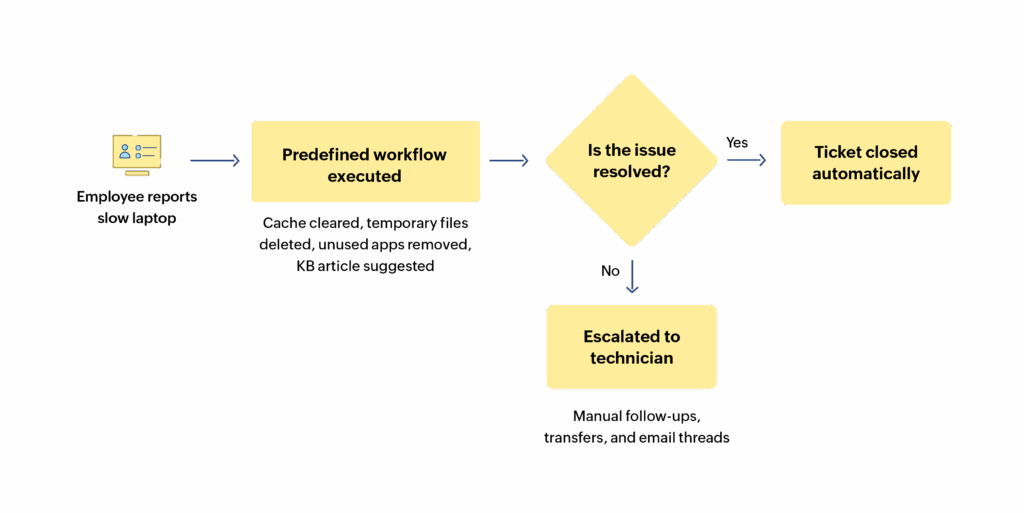
Consider a scenario where an employee reports a slow laptop. The system automatically triggers predefined workflows or suggests a knowledge base article. Sometimes, this helps fix the issue. However, when it doesn’t, the ticket is assigned to a technician. What should’ve been a few-minute fix can spiral into a string of manual transfers, reminders, and emails, delaying solutions for both end-users and technicians.
Why Traditional Automation Has Reached Its Limit
The biggest limitation of traditional automation is its rigidity. It follows rules – like reset this or restart that – but it can’t adapt to unexpected situations. While it can handle repetitive tasks quickly, it lacks awareness, reasoning, and the ability to learn from experience.
The result? The same old issues keep resurfacing, and IT service desks are left firefighting instead of focusing on more complex issues.
2. From Manual Fixes to Intelligent Automation: The AI-Driven Approach
As AI began making its mark in ITSM, it transformed how IT service desks operate – evolving from basic task automation to intelligent systems that can handle, prioritize, and even resolve issues with minimal human intervention. This shift has resulted in faster service delivery and a more seamless experience for everyone across the organization. But this is still without AI Agents.
How the AI-driven approach works
Let’s look at how this smarter, faster way of working comes together.
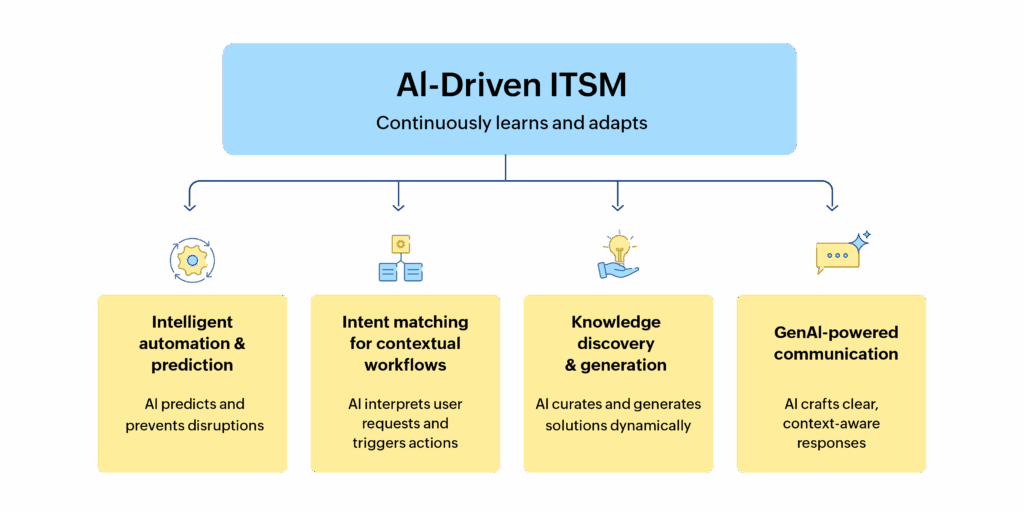
1. Intelligent Automation and Predictive Insights
Traditional rule-based automation – categories, subcategories, and technician assignments – is gradually being replaced by AI‑powered decision systems. These models learn from ticket data, technician expertise, and resolution patterns, automatically steering issues to the right teams. Over time, they can predict service hiccups by identifying patterns across assets, endpoints, and end-user behaviors, enabling IT service desks to take action before a ticket even appears.
Importantly, these AI models learn from everything the service desk handles – ticket data, technician expertise, resolution trends, and even end-user behavior. Over time, they spot patterns – such as recurring slowdowns after a patch or three consecutive account lockouts in one region – and flag issues before they escalate into incidents.
2. Contextual Understanding with NLP and NLU
AI models powered by natural language processing (NLP) and natural language understanding NLU help us break out of the constraints that once limited the scope of our use cases. Keyword matches, semantic nuances, and rigid rule-sets aren’t a limitation today because these AI models can interpret and understand the context of a request on their own.
For instance, when an end-user reports an issue stating “I need VPN access to work from home,” the generative AI (GenAI) powered virtual agent will not look for keyword matches. Instead, it understands the context and kickstarts the approval workflow.
3. Smarter Knowledge Discovery
AI acts as a smart, on-demand knowledge provider that instantly finds answers for common issues. When an end-user reports an issue through chat or while submitting a ticket, the system scans both public sources and the organization’s internal knowledge base to identify the most relevant solution article. It then compiles a clear, actionable summary, helping end-users quickly understand the solution.
4. GenAI-Powered Communication
GenAI enhances communication across ITSM channels, making them smoother and more effective. It helps service agents draft clear responses for L1 tickets, summarize lengthy conversations, and convey complex technical details in simple, user-friendly updates. The result is faster resolutions and consistent, accurate communication every time.
While the AI‐driven approach has improved ticket resolution time, it still needs human intervention when preset automations or standard AI suggestions can’t fully address an issue. This where AI Agents make a difference. They understand context better, make independent decisions, and take proactive actions across systems to resolve issues before they escalate. In doing so, they bridge the gap between automation and autonomy, keeping operations smooth and uninterrupted.
3. AI Agents: The Next Frontier of Self-Healing IT Operations
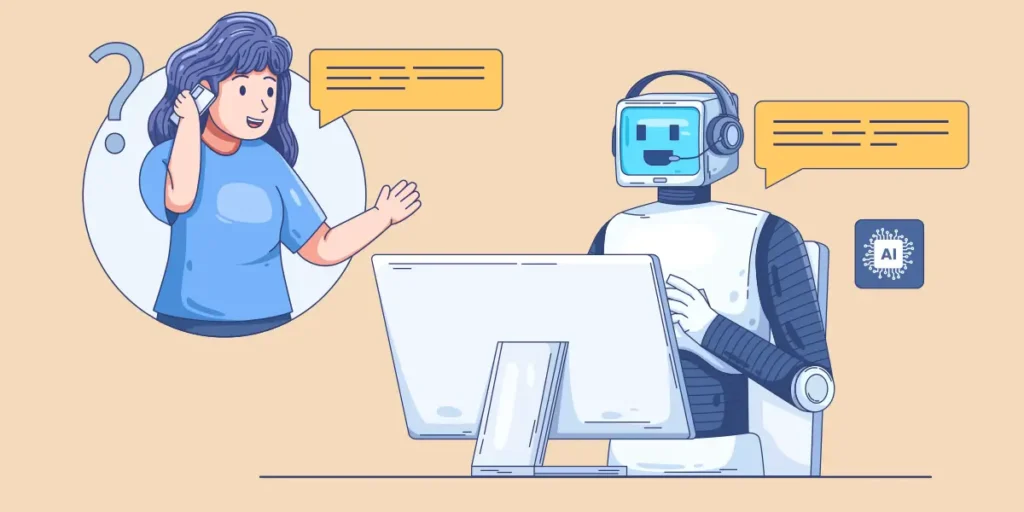
We can expect AI Agents to soon become the front line of IT support.
How AI Agents Diagnose, Fix, and Learn Autonomously
These intelligent agents can assess situations, make informed decisions, and carry out tasks independently, allowing human agents to focus on more intricate and strategic responsibilities.
Real-World AI Agents Example: From VPN Glitch to Instant Recovery
Here’s what that looks like in action:
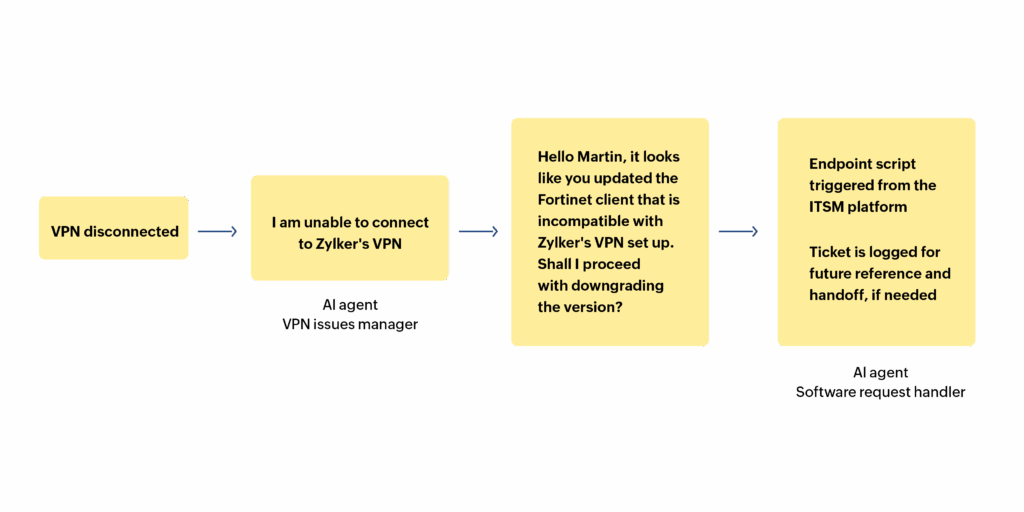
Step 1: AI Agents conversing with the end-user
When a VPN connection fails, the AI Agent doesn’t wait for a ticket to be raised. It reaches out instantly:
Hi Martin, I noticed your Fortinet client was updated to a version that doesn’t match your VPN configuration. Would you like me to roll it back to the previous working version?
Step 2: AI Agents diagnosing and fixing autonomously
Once Martin gives the go-ahead, the AI Agent fires the endpoint scripts directly from the ITSM platform – restoring access in seconds.
Step 3: AI Agents capturing context automatically
Even though the issue is resolved, the AI Agent still logs a ticket with full details. This helps ensure accurate documentation and helps IT teams track patterns and performance metrics.
Step 4: AI Agents learning with every interaction
AI Agents learn new information about end-user behavior, device dependencies, network performance, and system health through every incident that gets resolved. Over time, these agents evolve into comprehensive problem-solving systems that solve intricate situations at high speed, achieving precise results while gaining a deeper understanding of IT systems.
AI-powered L1 support will lead to a total transformation of IT support operations, generating measurable benefits and improved operational performance across all organizational departments.
The Future of ITSM: Self-Healing, Agentic, and Human-Centered
The Evolution from Bots to Intelligent AI Agents
As organizations become more comfortable with AI, L1 resolution will evolve into self-healing operations, where intelligent AI Agents not only identify issues but also diagnose the root cause and resolve them autonomously.
Towards Agentic AI Ecosystems and Zero-Touch Operations
In the coming years, we can see Agentic AI ecosystems where multiple AI Agents work together, share knowledge and insights, and delegate tasks among themselves. This will also change the role of humans, moving us away from troubleshooting and towards strategy, governance, and orchestrating AI-driven processes.
The Road to a Self-Healing Service Desk with AI Agents
We’ve come a long way from simple rule-based bots to smart virtual assistants – and now, AI Agents that can think and act on their own. Soon, these agents will serve as the first responders to L1 issues, enabling zero-touch, self-healing IT operations and seamless digital experiences. There are exciting times ahead!
Further Reading

Suganya Raju
With eight years of experience in IT services, Suganya Raju is an ITSM content marketing expert at ManageEngine. She creates articles, in-depth guides, eBooks, white papers, and thought leadership content on IT service management and emerging technology trends. Through her work, she helps IT leaders and practitioners navigate complex challenges, strengthen service delivery, improve operational resilience, and adapt to an evolving technology and compliance landscape.