
For IT service management (ITSM) teams that want to transition from documenting processes to creating process maps that deliver value, are trusted, and last the course, the starting point is treating them as more than just process maps. However, a robust process library requires the right “inputs” before it can drive the right “outputs.” These inputs include defining governance, creating active stakeholder engagement and taking a lifecycle approach to ongoing updates and continual improvement.
In this blog, I explore how to move beyond static repositories where process diagrams metaphorically gather dust on a shelf. The ideal scenario is a process library that evolves, aligns, and improves service delivery over time, because processes themselves change.
It takes commitment and effort, but the rewards from building a process library that genuinely supports how your organization delivers and improves services are well worth it.
Why Process Libraries Matter in ITSM
The Business Value of Process Mapping
Most ITSM teams understand the value of process mapping: clear workflows help standardize service delivery, support employee onboarding, improve transparency, and provide a platform for continual improvement.
The diagram below shows that 64% of respondents to a CTMS survey reported using process maps to improve their workflows.
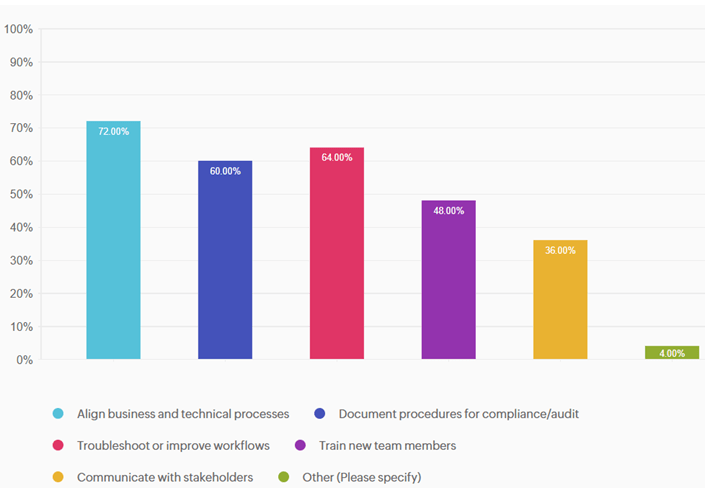
However, the same survey highlighted an ongoing problem: 80% admit that their diagrams don’t reflect how things work in the real world.
Why Many Process Libraries Fail to Stay Relevant
There are some common reasons for this gap between intentions and reality:
- Process diagrams are created as a one-off exercise rather than an ongoing asset, and as a result, they age fast
- Lack of stakeholder buy-in: only 36% of respondents use process maps for stakeholder communication
- There is no formal governance or ownership model in place from the outset for process updates.
Process Maturity and the Reality Gap
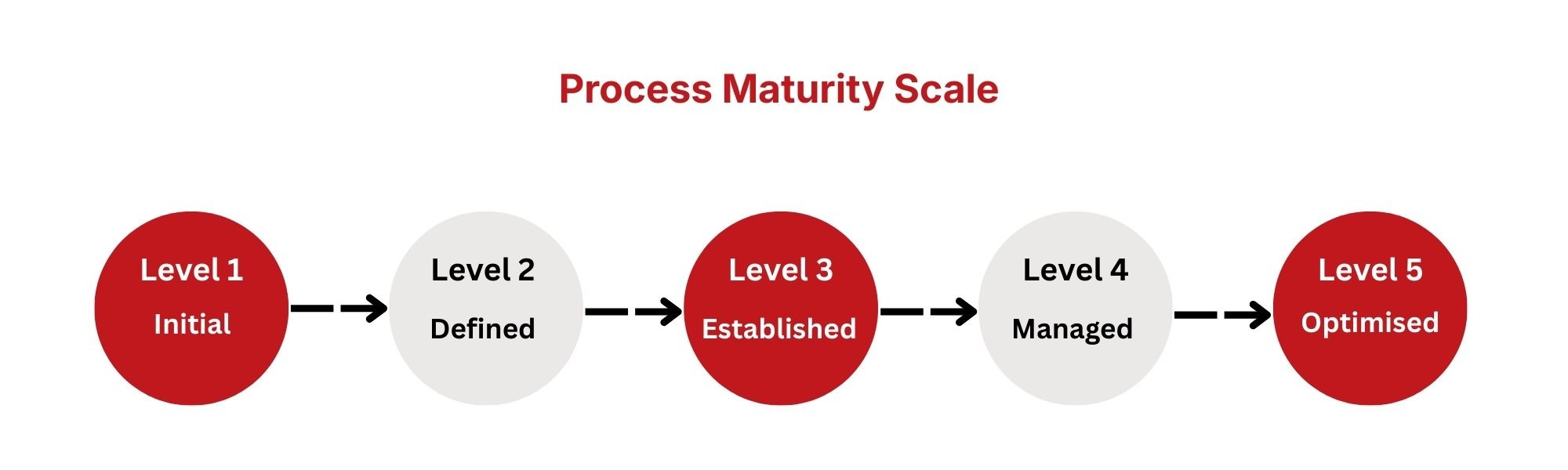
Another key influence here is the existing level of process maturity. Looking at the diagram below, most organizations are typically at Level 2, i.e., processes are not universally documented and are often performed ad hoc.
But process mapping technology itself is rarely the issue. It is more about having the right frameworks in place to ensure value and relevance.
Because of these challenges, even the best process library can quickly age. What happens next is that users stop looking at them, the diagrams become even more outdated, and the value they deliver erodes over time.
Establishing Governance for a Sustainable Process Library
No organization sets out to see its process maps become devalued. But how do you prevent this? To ensure a process library becomes a trusted resource, there are four areas to focus on:
1. Defining Clear Process Ownership and Accountability
It is important to assign clear process owners to each major process map you build. They are accountable for ensuring that the map remains accurate, relevant, and aligned to service delivery goals. They need to be part ambassador and part whip-cracker, ensuring updates actually happen in a timely way and that standards are maintained.
It is worth considering whether you need a more formal governance mechanism, e.g., a process review team that meets periodically to assess process health, manage changes and approve replacements. This aligns with best-practice frameworks such as ITIL, which build continual improvement into their processes.
2. Building the Right Skills and Process Mapping Capability
Process mapping is so much more than drawing boxes and inserting arrows! Running high-impact workshops, facilitating stakeholder engagement, and driving the right outcomes require facilitation, subject-matter expert (SME) coaching, and visualization skills.
It is important to develop or appoint process-mapping champions who can guide the sessions, bring the right stakeholders into the room, and keep the momentum going.
3. Designing a Process Lifecycle and Update Model
A set of process maps or a process library is not static. You need to define a lifecycle that includes:
- Baseline or the “as is” map
- Validation with stakeholders
- Identification of opportunities for improvement
- Transition to the desired “to be” state
- Regular review frequency cadence
- Retirement/replacement/archiving of maps that have become obsolete, perhaps due to organizational changes
- Additional aspects such as versioning, change logs, and archive references to provide a clear audit trail of how process maps have evolved and why.
4. Setting Standards and Selecting the Right Tooling
Set clear standards for how process diagrams are formatted, how role responsibilities are shown (such as using a RACI matrix), and how systems interact with process tasks.
As identified above, use appropriate tooling that supports collaboration, version control, and publication. But remember: tools are enablers, and they do not ever provide the whole solution.
Insights from one process mapping vendor highlight that process mapping helps “visualize workflows, highlight inefficiencies and support business intelligence and compliance.” That underscores the need for live, up-to-date maps.
Running Effective Process Mapping Workshops
A process library is only as good as the accuracy and relevance of its process maps. In my experience, the best way to create maps that reflect real-world operations is through a robust process-mapping workshop(s).
Preparing Stakeholders for Successful Workshops
Before a process mapping workshop, identify and invite all relevant stakeholders to participate. This could include process owners, ITSM platform owners, customer-facing agents, and other support staff.
It is useful to set clear expectations at the outset for the process scope, goals, and expected output. According to the CTMS survey, “lack of stakeholder participation,” which 40% cite as a challenge, is a key reason process maps age quickly.
Note that we haven’t talked about process mapping tools so far. One is required, but how it is used within the workshop to support live collaboration is more important than the specific tool itself.
Mapping Real-World Processes at Speed
In a well-run workshop, you can build the process map in real-time, capturing the thoughts of the people in the room. It is possible to create process maps as fast as the stakeholders and SMEs can describe them.
This creates buy-in, speeds up delivery, and highlights issues early.
Other aspects to consider include:
- Ensure the workshop stays focused on achieving the goals and doesn’t get bogged down in endless back-and-forth discussions on the same issues.
- Use clear, consistent process formatting to clearly show roles, systems, and hand-offs.
- Ensure everyone is ready to challenge any underlying assumptions. It can be enlightening to find out the answer to: “Is this really how we do it?”
- Highlight gaps, duplications, or areas of risk immediately. These will serve as follow-up improvement actions after the workshop.
- Ensure you capture the knock-on impacts or consequences of an updated process, as these could affect compliance or reporting, for example.
Validating, Publishing, and Maintaining Process Maps
If the workshop has been run effectively, in theory, there should be less of the to-and-fro you often get when multiple people review the same document.
Version Control, Metadata, and Audit Trails
Once the workshop is complete, publish the agreed process map to a broader stakeholder audience, invite comments, and aim to finalize it quickly. Once complete, ensure the process map is stored in the correct repository with the appropriate metadata, version control, and links to underlying documentation (SOPs, work instructions, KPIs, etc.).
How well organizations manage what happens after a process has been documented contributes to its maturity on the process maturity scale.
Embedding the Process Library into Service Delivery
Creating the process maps should be seen as the beginning. For long-term success, the process library must be embedded in how the service team works – it should not exist outside the way work takes place.
Making Process Maps Visible and Accessible
The effort that has gone into creating your process maps should be reflected in how they are viewed – ideally as a single source of truth. It should be ingrained into onboarding materials, self-service portals, training platforms, and change programs.
The more people who interact with the process library, the more value it brings and the more opportunities for feedback.
Using Process Maps in Day-to-Day ITSM Operations
Encourage teams to refer to the maps when:
- Determining the right course of action to follow
- Preparing for audits or compliance reviews
- Designing changes or new automations, but remember the adage “you shouldn’t automate a bad process”
- Reporting metrics or KPIs: process maps can help identify root causes, incorrect hand-offs or delays.
Supporting Audits, Change, and Automation Initiatives
Reviews of the process maps should take place at regular intervals and also when metrics, such as the date they were last updated, the number of views/downloads, or stakeholder satisfaction rates, reach certain trigger levels.
Where maps haven’t been touched for a sufficient period of time, it is worth questioning whether they still reflect reality.
Avoiding Common Process Library Pitfalls
Many companies fall victim to the various pitfalls that lie on the road to success. These include:
When Process Maps Are Created and Forgotten
Without the active governance and visibility described above, maps can easily date. Consider whether the process owner should carry a KPI and visible responsibility for maintaining the process map and integrating reviews into change management workflows.
The Risks of Too Many Inconsistent Process Maps
What’s worse than too few process maps is a library of many, each following its own format or standard. This is a surefire recipe for issues further down the road. Ensure you have an adequate process architecture and that all your maps align with it.
Tool-Led Mapping Without Governance
Experience shows that investing in mapping tools or automation without having the right supporting framework rarely works. Get the governance and other framework basics in place before you jump into tooling or scaling automation.
Documenting the Desired State Instead of Reality
If your process maps show how you’d like to work rather than how you actually do, they won’t help drive continual improvement. This comes back to the original process workshops and ensuring you have the right people in the room who can validate what actually happens.
Measuring and Proving the Value of Your Process Library
Operational Metrics That Demonstrate Process Library Impact
To show value to the business, you need to measure and communicate value from the process library. Examples include:
- Reduction in process-related incidents, such as incorrect hand-offs between teams or ticket misallocations
- Faster onboarding of new staff
- Number of process maps referenced in training or change programs
- Percentage of maps reviewed/updated in the last 6-12 months
- Stakeholder satisfaction or usage metrics (views/downloads).
Linking Process Improvements to Business Outcomes
Linking these back to business outcomes, such as improved service delivery KPIs or reduction in escalations, will help cement the process library’s reputation as a strategic asset.
Advancing Process Maturity with a Living Process Library
Moving Toward Measured, Owned, and Visible Processes
All businesses would benefit from a shift to the right on the process maturity scale. Aiming for Level 4, where processes are measured, owned, and visible to key stakeholders, is a reasonable objective.
How Process Libraries Enable Continual Improvement
A well-thought-out process library can help ITSM teams align people, processes, and technology and evolve and transform how they deliver services.
If you have a robust approach to process mapping, your processes will, by default, undergo scrutiny, which in turn drives continual improvement.
Achieving Higher Process Maturity One Step at a Time
Together, these two initiatives are key steps toward achieving Level 5 on the process maturity scale. This is where processes are visible to all stakeholders, collaboration is greater, continual improvement is a focus, and alignment with strategic goals and objectives is achieved.
Level 5 can only be realized one step at a time and requires an investment of time and effort into ensuring the process library is treated as a living asset with clear governance.
Please get in touch if you are interested in discussing any aspect of improving the level of process maturity in your organization.
Further Reading

David Keen
David Keen began his career in financial management before transitioning into IT, where he specialised in service management. Over the past twenty-five years, he has led and contributed to a wide range of IT consultancy projects. His passion for aligning IT with business goals remains as strong as ever, especially amid the transformative impact of emerging technologies like AI.