
This article explores the role of maturity models in Service Management and IT service management (ITSM) – what they do well and where they often fall short – and introduces a more practical approach your organization can adapt to drive meaningful improvement.
What Service Management Maturity Models Get Right
Established frameworks such as ITIL, CMMI, and COBIT provide a structured approach to assess capabilities, establish a common language across teams, and identify areas for improvement.
6 Common Challenges with ITSM Maturity Models
While existing maturity models vary in scope, terminology, and application, most share the same six recurring issues that limit their usefulness:
- Subjective terminology. Most maturity models use vague terms and phrases such as “improved” or “consistent,” which makes it difficult to train and deploy.
- Unclear value/Return on Investment (ROI). The benefits achieved by progressing through the various maturity levels are often unclear.
- Opaque scoring. Proprietary or unclear scoring can reduce trust and buy-in to maturity models and their recommendations.
- Delayed continual improvement. Continual improvement often appears only at higher maturity levels, rather than being embedded as a consistent practice from the start.
- Weak integration of technology. Few maturity models explain when or how to adopt modern tools such as automation, artificial intelligence (AI), machine learning, or advanced analytics in alignment with maturity progression and business value.
- No roadmap for alignment. Teams and service management components (practices, tools and technologies, and structures) are often assessed in isolation, leading to gaps and inconsistencies across the organization.
What a Practical Service Management Maturity Model Looks Like
A practical maturity model should be clear, measurable, and designed to scale with the organization. The approach outlined here shows how practical service management principles can be applied to create a tangible, real-world maturity model.
It emphasizes measurable outcomes, scalability, and adaptability, helping organizations bridge the gap between theoretical frameworks and actual practice.
In this maturity model, the term “service management components” is used intentionally. Rather than focusing only on practices or processes, the maturity model evaluates the broader service ecosystem, including practices, organizational structures, and supporting tools and technologies. These elements are treated as distinct components because each independently influences how services are delivered and improved. Assessing them separately helps organizations avoid a common maturity pitfall: improving individual practices while the structures and technologies that support them remain inconsistent across the organization. Service maturity ultimately depends on how well these elements operate together across the service ecosystem.
In other words, service maturity is not determined solely by practices, but by the alignment of teams, practices, and technologies across the organization.
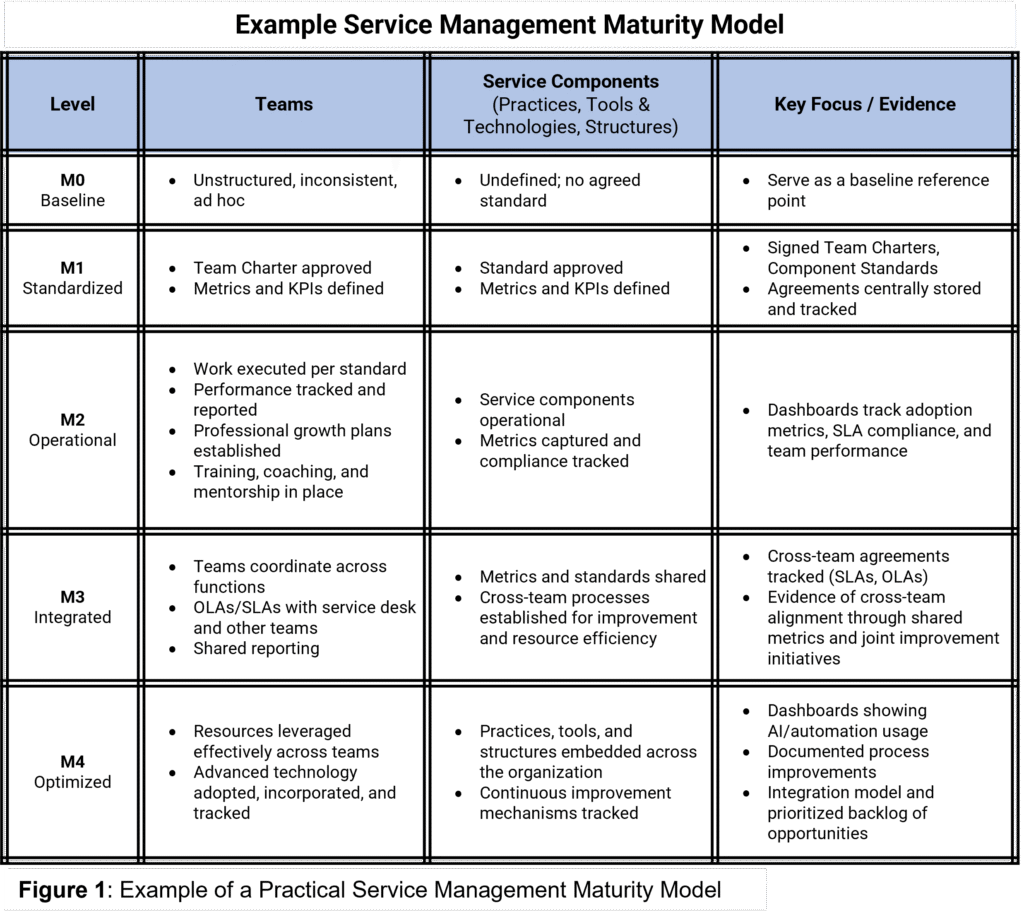
The 5-Level ITSM Maturity Model Explained (M0–M4)
The following maturation process outlines how an organization might operationalize this approach in practice. Each level represents a logical progression based on evidence and observation, and is intended to be refined over time as teams learn and adapt.
Maturity Level 0 (M0) – “Inconsistent”
Primary Objective
This level aligns with most existing maturity models. It serves as a baseline for all teams to ensure consistency and recognize the randomness and disorganization often associated with immature service teams and service desks.
Maturity Level 1 (M1) – “Standardized”
Teams
The first logical step for any team, whether a service team or service desk, is to define the services for which they are accountable, how those services are delivered and supported, and how success is measured. This can be captured in a well-structured team charter to provide clarity, consistency, and accountability.
Team Charter Contents
The following are examples of content that might be included in a maturity model’s team charter:
- Mission statement
- List of services provided
- Clear roles and accountability
- Client categories and descriptions
- Vendors and partners
- Practices and documented gaps
- Performance metrics and key performance indicators (KPIs).
All teams should use a common template for consistency. The goal is to ensure every team follows a common format and set of expectations.
Components
Similarly, each practice, tool/technology, or personnel type should have a documented component standard that defines its purpose, who it serves, associated roles and responsibilities, and how success is measured.
Component Standard Contents
A maturity model’s component standard documents how a specific component is executed, managed, and measured. Typical contents include:
- Objectives and outcomes
- Related processes
- Current maturity status
- Defined roles and responsibilities
- Defined communication channels
- Training plan and requirements
- Roadmap placement and schedule
- Performance metrics and KPIs.
As with the team charter, component standards follow a shared organizational template for consistency.
Organizational Evidence
Maturity model charters and standards should be centrally stored and tracked using standard enterprise tools, providing tangible proof of adoption.
Why it Matters
Standardization ensures everyone understands their responsibilities, establishes a baseline for measurement, and creates a foundation for continual improvement.
Maturity Level 2 (M2) – “Operational”
Teams
Teams track and report the type, volume, and complexity of the work they handle and assess how staffing, skills, and processes align with demand. This includes:
- Identifying training, coaching, and mentorship opportunities
- Establishing professional growth plans, and
- Implementing training to address skill gaps
Components
Track and report on adherence to agreed standards, processes, and compliance requirements. Shared metrics can indicate actual adoption and usage across the organization.
Organizational Evidence
Dashboards provide a consistent view of work volume, trends, throughput, and capacity across teams, using shared definitions and formatting.
Why it Matters
Operationalization, in maturity model terms, ensures that standards are applied consistently, provides clarity on actual performance, and identifies opportunities for improvement (e.g., staffing, training, process).
Maturity Level 3 (M3) – “Integrated”
Teams
Teams focus on how work is integrated and managed across the organization. This includes establishing agreements with the service desk and other teams to clarify responsibilities and define target metrics.
Components
Metrics and standards are shared and consistently understood across teams. Processes are in place to identify opportunities for improvement, track resource usage, and optimize efficiency.
Organizational Evidence
Approved operational and service targets and cross-team dashboards demonstrate integrated operations. Note: Using the same toolset can ensure smooth handoffs and consistent reporting across teams.
Why it Matters
Integration helps ensure teams and components operate cohesively, aligning objectives, improving efficiency, and supporting consistent service delivery across the organization.
Maturity Level 4 (M4) – “Optimized”
Teams
Teams collaborate seamlessly across the organization, leveraging shared resources and automating and analyzing data to measurably improve service delivery.
Components
Practices, tools, and personnel are fully integrated across the enterprise. As maturity improves, AI-driven automation and analytics are embedded in operations. The organization establishes clear processes and protocols for these integrations, including how their effectiveness is measured. This helps ensure that technology adoption aligns with objectives, is consistently incorporated, and is continuously improved based on real-world results.
Organizational Evidence
Dashboards are used to track the impact of automation and analytics, document process improvements, measure resource optimization, and track a prioritized backlog of improvement opportunities.
Why it Matters
Optimized teams and components operate proactively, using data and technology to anticipate needs and continually improve service quality.
Automation and AI are used to offload repetitive or low-value tasks, allowing people to focus on higher-value analysis, innovation, and service improvement. Technology adoption is effective only when processes, structures, and roles are clearly defined and mature.
Key Benefits of a Practical, Evidence-Based Maturity Model
This practical maturity model offers several advantages that make it easier to adopt and sustain maturity efforts:
- Logical progression. Each level builds clearly and objectively on the previous one, creating a logical path toward maturity.
- Practical and evidence-based. Leaders and teams can easily identify, measure, and communicate their current state, next steps, and the value gained by advancing to the next level.
- Unified. Teams and components mature using the same, consistent framework.
- Scalable. This approach encourages consistency across practices while avoiding “paper maturity,” in which processes exist only on paper and aren’t truly adopted.
- Aspirational. Introduces AI-driven automation and analytics only after foundational maturity is in place, as a logical step to improve efficiency and effectiveness.
How to Apply the Maturity Model in Your Organization
This maturity model follows a logical progression D → M → A → O:
- Define clear standards and expectations
- Measure performance and maturity objectively
- Align teams and components through shared goals, and
- Optimize through data-driven improvement.
All service teams begin at M0, a pre-standardized state. Structures, roles, and measures may exist informally but are not yet defined or consistently adopted across the organization.
Teams advance only after demonstrating with clear evidence that all requirements for the next maturity level are met. This helps ensure consistency, prevents “gaming the system,” and promotes objective, evidence-based progress.
While the maturity model outlines a progression from M0 → M4, organizations should treat it as a living framework, revisiting and refining practices as they learn what works best for their unique environment.
Foundational Requirements for ITSM Maturity Success
Before any team advances, the organizational components that enable them, such as governance structures, core practices, and supporting tools/technologies, must first achieve M1 (Standardized). In other words, foundational elements must mature first so that teams can build upon stable, consistent frameworks. This helps ensure that:
- Each related component has clearly defined scope, roles, and performance measures.
- Teams operate within consistent structures, expectations, and systems that enable alignment and accountability.
A shared organizational glossary helps ensure consistent terminology across teams and reduces confusion during alignment.
Consistent Templates
Standard templates should be established to maintain uniformity and clarity across the enterprise. This includes:
- A team charter template that defines what services a team provides, how it delivers them, and how success is measured.
- A component standard template that defines each process or practice’s purpose, scope, roles, and performance measures.
Applying in Practice
Once foundational components reach M1, teams can then progress through the maturity model levels by demonstrating evidence in the following four key areas:
- Foundation/Standardization. Teams adopt and apply the defined charters and measures defined by the components.
- Operationalization. Metrics, reporting, and continual training are implemented to help ensure consistent execution.
- Integration. Collaboration and shared accountability across teams are evident.
- Optimization. Data-driven improvement, automation, and other intelligent tools are leveraged to maximize efficiency and value.
This sequence helps ensure that maturity is systematic, transparent, and sustainable. It represents a continual, organization-wide progression rather than a one-time assessment.
Conclusion: Moving from Theory to Practical ITSM Maturity
When standardizing practices across an organization, all stakeholders and participants must understand not only the direction and expectations, but also the “why,” the value of the effort. A clear, practical maturity model, supported by standardized templates, coaching, and a simple framework such as D → M → A → O (Define, Measure, Align, Optimize), grounded in tangible, value-based deliverables, can provide the clarity often missing in large-scale transformation efforts.
Finally, when adopting any model, it’s crucial to set expectations from the start on communication methods, engagement strategies, and the expectations tied to each level. Plan ahead for structured training and coaching, and establish both formal and informal channels for individuals and teams to share feedback and get answers to their questions.

Troy Kinsey
Troy Kinsey is the founder of Kinbalo Ventures and a service operations consultant with nearly two decades of experience in IT service management and more than 30 years leading technology and service organizations. He is the author of Practical Service Management, which presents practical methods for assessing and improving service organizations.