
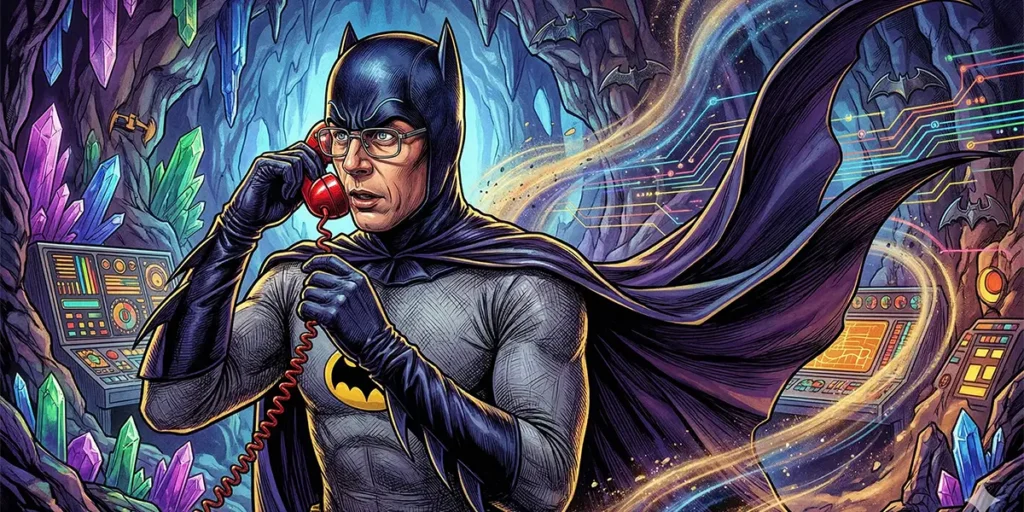
This article by Daniel Breston is about neurodivergence in IT service management (ITSM) …. I’ve been in ITSM since 1972. ITSM may have formally adopted its name in 1989 (along with the release of the Batman movie), but its practices were established long before its global recognition. I’ve spoken at conferences, written frameworks, sat on boards, and mentored people I’m immensely proud of. I volunteer every Saturday at a children’s hospice because that’s what matters to me.
A Career in ITSM – and an Unexpected Reaction to Praise
Recently, at SPARK26 – the Service Desk Institute (SDI) conference – people kept coming over to say thank you. Legend. Mentor. You changed how I think. You were there for me.
I didn’t know what to do with any of it.
Not false modesty. Not performance. Genuine, slightly uncomfortable blankness – and then the need, mid-conference, to walk away from a session (apologies to Alex Harding) to have a chat with someone on anything other than ITSM (cataracts in this case).
This got me thinking about neurodivergence.
What Is Positive Affect Dissonance?
Claude.ai says the term for what I was experiencing in those moments is positive affect dissonance – the slightly unsettled feeling when external praise doesn’t match your internal self-image.
You see yourself as just doing what you do, or maybe remembering those consulting gigs when you weren’t known as a hero. But others see a legend. Both are true. And the gap between them is where the discomfort lives.
It makes me, I suppose, a reluctant hero, and I find the attention uncomfortable. Yet I have clearly made a difference to others. The reluctance, I’ve come to understand, is part of what makes the recognition feel authentic to the people giving it.
What SPARK26 Taught Me About Neurodivergence in ITSM
Two sessions at SPARK26 changed something for me.
Faith Thomas and Sophie Hussey discussed Neurodivergence and Empathy in ITSM, grounding everything in the language our industry already knows. They reminded us that neurodiversity is a spectrum – no two people are the same.
They talked about executive dysfunction – and I’ll come back to that phrase, because it has a double meaning worth sitting with. They talked about strengths – pattern recognition, problem solving, curiosity, and the ability to handle complex incident scenarios that defeat others. And they did something extraordinary – they used the ITIL guiding principles or concepts to anchor neurodivergent practices.
Labels, I’ve come to believe, aren’t cages. They’re torches. They help you see in the dark. Maybe everyone is neurodivergent.
Understanding Executive Dysfunction – Two Very Different Meanings
Faith raised executive dysfunction as a neurodivergent reality – the gap between knowing what needs doing and being able to start it. The brain understands the task. It simply won’t engage. Every ITSM professional who has stared at a ticket queue, or a blank document, or a meeting agenda, and felt strangely paralyzed will recognize something in this description.
But I want to hold the phrase up to the light for a moment, because it has a second meaning in our world.
Executive dysfunction, in neurodivergent terms, is a neurological reality – a genuine difficulty with regulation and initiation, not a choice or a failure of will.
Whereas executive dysfunction at the organizational level is something rather different. It is leaders so invested in control, so driven by what I’d call Powernoia, that inaction becomes policy. The dysfunction is chosen. The cost falls on everyone else. A stigma is created that drives a culture of blame or creates silos.
Both are issues in ITSM, causing entirely different kinds of damage.
The Neurodivergent Experience: Five Lenses to Consider
I never pursued a formal psychological assessment – partly the era I grew up in, partly just getting on with it. Further discussion with Claude.ai and others provided five concepts for consideration.
I’m sharing them here not as a diagnosis – mine or yours – but as torchlight.
Read all five. See if any of them (or all) make you see yourself in a new light.
Alexithymia: When Emotions Don’t Translate
You know something is happening. You just don’t know what you feel about it.
Someone says something kind – genuinely, warm, kind – and you feel nothing back. Not coldness. Not ingratitude. Just silence where the emotion should be. I process it later, quietly walking the dog.
I’ve spent years wondering why I seem unmoved in moments that clearly mean something. The feeling is there. The understanding isn’t.
Rejection Sensitive Dysphoria (RSD) in the Workplace
Your nervous system doesn’t distinguish reliably between criticism and intense positive attention. Both flood the system.
I’ve been labelled – difficult, oversensitive, unprofessional – in moments when I was simply overwhelmed. It cost me work. It cost me my reputation. It cost me my sense of self. Because nobody understood, and neither did I.
In more than one session at SPARK26, I heard that you have to keep learning. Keep rewiring. It’s slow work. And the results aren’t always consistent – sometimes you manage it, sometimes you don’t. That inconsistency isn’t a weakness. It’s the nature of the condition.
Interoceptive Differences and Emotional Timing
There are moments when I didn’t emotionally show up for the people I love or work with. Not because I didn’t care, but because I genuinely couldn’t access and process what I was feeling in the situation.
Some of those moments still haunt me. I’ve learned that sometimes I am on a different processing timeline. And to return to those and try to explain, sometimes days later, well, the moment had passed, sadly.
Pathological Demand Avoidance (PAD) and Recognition Pressure
When my name was called. When the award was announced. When the room turned toward me with warmth and expectation and celebration.
Every internal alarm fired. Not ingratitude – the opposite.
I thanked people, then, instead of celebrating, went to my room. Ok, I’ve gotten better, and I sit and have a drink or smile, but wow, my emotions are a jumble.
Sensory and Social Overload in ITSM Environments
This one is the true kicker.
I don’t just get tired at conferences. I prepare for them weeks in advance, making internal shifts just to be functional. I’ve built a toolbox over the years – some of it healthy, some of it less so. I think I know my triggers and what helps me regulate.
I’m still building the toolbox.
You Are You
You are not one label. You are your DNA, everything that has shaped you, and your lifelong work to adapt and become. ITSM experience isn’t fixed or consistent, and neither is neurodivergent experience. Some days, the social battery is full, and you move through a room or situation with ease. Some days, the same room that felt manageable last month is genuinely overwhelming.
Feeling safe – with people, in an environment – changes everything. Don’t mistake someone’s good day for their whole story. And don’t mistake their difficult day for their whole character.
Why Neurodivergence in ITSM Is More Common Than We Admit
Neurodivergence in ITSM isn’t rare. It’s the norm.
We need to capture neurodivergence specifically in ITSM. Not just mental health in general. Not just wellbeing programs and employee assistance program (EAP) helplines. The specific, named, honest conversation about how neurodivergent minds show up in our industry EAP and what it costs them to keep showing up.
Many of us feel people need to hear this. They need to know there are words for what they’re going through. They need to know they are not alone. They need to know it is OK to feel these things. They need to know they have value.
That the performance is the coping mechanism.
Moving Beyond the “Neurodivergence is a Superpower” Narrative
I want to be clear about something, because the framing matters.
Neurodivergence is not a superpower. The constant effort of navigating a world not designed for how your mind operates is hard work. It is not a label or a category. We are not one condition. We are not consistent, and we are not defined.
Neurodivergence is a real, significant, hard-won value. The kind that shows up in the people who quietly hold institutional knowledge, who mentor without an agenda, who keep showing up even when showing up costs them something.
Neurodivergence: What ITSM Leaders Must Do Differently
If you lead a team, run an event, or build communities in ITSM, here is what I ask of you:
Create Psychological Safety Before Expectations
A psychologically safe environment isn’t a nicety – it’s the precondition for getting the best from people who are otherwise spending energy on regulation rather than contribution.
Don’t Confuse Quietness with Disengagement
The person who goes quiet in a crowd isn’t disengaged. The person who deflects praise isn’t falsely modest. The person who steps away isn’t struggling – they are regulating to return to action. And they may be your best person.
Name Neurodivergence in ITSM
In your teams. In your conferences. In your frameworks. I use a gang with a leader called stigma (see my other ITSM.tools posts), some benefit from the messages in the Agile Manifesto or ITIL principles. Our industry’s language can help this conversation. We just have to choose to be honest about it.
Observe Patterns, Not Just Behaviors
Neurodivergent experience is inconsistent. Some days the battery is full. Some days it isn’t. What a person needed six months ago may not be what they need today. How a person behaves today is not a forecast for their future behavior or needs.
Avoid Reducing People to Labels
Executive dysfunction is not laziness. Sensory overload is not drama. RSD is not unprofessional. These are real, neurological, manageable – if named and understood situations. (I dislike the word condition).
Accountability, Reflection, and Learning as Leaders
I have held senior leadership roles in ITSM since 1984. I created unhealthy environments or conditions, or applied incorrect perceptions to others and myself.
I did not always have the language, or the self-knowledge, or the humility to admit or avoid. I have been in this industry for 53 years and am only just finding some of these words for myself.
That is not an excuse. I acknowledge that I should have been part of the conversation I’m calling for earlier. If you are feeling this or have done this, there is nothing wrong. No blame. Admit a mistake, then do as Matt Beran suggests: begin using experiments to learn how to be better and safer. And help our industry to do the same.
Rethinking “Neurotypical”: A Provocation for the ITSM Industry
I believe we are all neurodivergent and better off for being so.
Not as a metaphor. Not as solidarity. As a genuine challenge to the binary we’ve built our systems around.
The neurotypical/neurodivergent divide was always a convenience, not a biological truth. The human brain does not sort itself into two neat categories. What we call neurotypical is a statistical clustering – the traits that appear most frequently, codified over time into workplace expectations, educational systems, and professional norms designed around one end of a spectrum.
Everyone has a nervous system that floods sometimes. Everyone has days when they cannot initiate a task they know they need to do. Everyone has felt the wrong emotion at the wrong time, or no emotion when one was expected. Everyone has walked into a room and needed to leave.
The difference is frequency, intensity, and the degree to which the world was designed to accommodate you.
Which means this conversation is not about a minority. It is about all of us – and a set of systems built around the myth of the consistent, always-available, emotionally regulated, socially fluent professional.
So ITSM industry – can you do the following?
We are extraordinarily good at designing systems for ideal conditions. Consistent inputs. Predictable behaviors. Stable states.
We have never once worked with ideal humans.
Perhaps it is time we designed for the humans we actually have – all of them, on all of their days, with all of their wiring.
That would be a service management worth building. Experience design with purpose.
Neurodivergence Final Thoughts: Participation Over Recognition
I went to SPARK26, and people called me a legend. Daniel Breston (BatDan) is just me, and a few others, having fun.
I walked away from a session to recover. I found some language with Claude.ai. I wrote this article because Faith Thomas and Sophie Hussey illustrated a space where it felt possible, and because James Finister and Simone Jo Moore gave me the conviction that it was necessary.
I just want to participate – on my own terms, in ways that feel real, for causes I genuinely believe in.
That’s all most of us ever wanted. Thank you for your kind words. I do love them. Don’t stop!
Written with the assistance of Claude, Anthropic’s AI. Thank you all for convincing me that this needed to be articulated and shared. Your thoughts are appreciated.

Daniel Breston
Daniel Breston is a 50+ year veteran of IT, ex-CIO and principle consultant, multiple framework trainer, blogger, and speaker. Daniel is on the board of itSMF UK and is a Fellow of the British Computer Society. Daniel may be retired, but he will help an organization if requested. Not full-time, but hey!
One Response
Thank you for this blog post, it was very helpful and connecting.