
The discipline of IT service management (ITSM) isn’t just about “keeping the lights on”; it’s also about delivering better services, experiences, and business outcomes over time. This is where the ITIL 4 continual improvement practice plays a critical role.
Why Continual Improvement Matters in Modern IT Service Management
In ITIL 4, what was previously called continual service improvement (CSI) in ITIL v3 2011 Edition has evolved. Now called continual improvement, it’s no longer a standalone book (one of five that covered the ITIL service lifecycle) but one of ITIL 4’s 34 management practices. While this is a “structural” change, there’s also a more meaningful shift in focus that’s covered by the new name.
What “Continual Improvement” means in ITIL 4 (vs. “Continual Service Improvement”)
Quite simply, ITSM improvement isn’t limited to services. It also applies to IT products, practices, operations, and outcomes. Hence, dropping “service” from the name reflects this broader scope.
Understanding the Continual Improvement Practice in ITIL 4
According to the PeopleCert ITIL 4 Continual Improvement Practice Guide:
“The purpose of the continual improvement practice is to align the organization’s practices and services with changing business needs through the ongoing improvement of products, services, and practices, or any element involved in the management of products and services.”
In other words, continual improvement is not just about following a process. Instead, it’s about embedding a mindset of improvement across the entire organization.
How Continual Improvement Evolved from ITIL v3 CSI
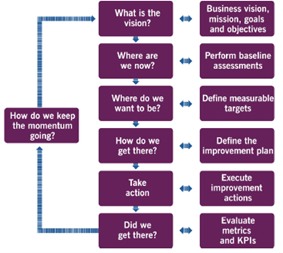
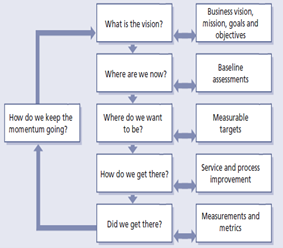
The ITIL 4 model builds on ITIL v3 2011 Edition’s CSI model but introduces a key new step: “Take Action” – placed between “How do we get there?” and “Did we get there?” as shown below.
| ITIL 4 | ITIL v3 2011 Edition |
 |  |
| Source: PeopleCert, ITIL 4 Continual Improvement Practice Guide | Source: PeopleCert, ITIL v3 2011 Edition CSI Publication |
Why Continual Improvement Is Now a Core ITIL 4 Practice
This change emphasizes execution. It turns good intentions into results by helping ensure the plan isn’t “stuck on paper.” Additionally, the guidance in ITIL 4 is more action-oriented, assisting teams to not just think about improvement but actually deliver it.
Common Challenges with ITIL 4 Continual Improvement
Implementing continual improvement is not always easy. Common roadblocks include:
- Lack of leadership support
- Limited resources or skills
- Change resistance among staff
- Poor communication
- A short-term or reactive mindset.
Why Prioritization Determines Improvement Success
Prioritization is key to the success of continuous improvement. No organization has unlimited resources, so your organization must prioritize improvements that offer the greatest value. This might mean:
- Solving recurring pain points raised in end-user feedback
- Fixing operational bottlenecks
- Replacing ineffective tools or processes.
Using ITIL 4 Guidance to Strengthen Continual Improvement
Insights from the Direct, Plan, and Improve Practice Guide
The ITIL 4 Direct, Plan, and Improve publication offers deep insights for each step in the continual improvement model. For example, during planning, it recommends asking questions such as:
- Are there quick wins we can deliver early?
- Do some changes depend on others?
- Are there resourcing constraints?
Linking Continual Improvement to Digital and IT Strategy
There’s also helpful strategic guidance in the ITIL 4 Digital and IT Strategy publication, which uses the continual improvement model to drive organizational transformation.
Best Practices for Embedding Continual Improvement into Your Organization
- Treat continual improvement as a capability, not just a process.
- Secure stakeholder support and initial funding, then start small and scale based on success.
- Align goals with business strategy to stay focused on outcomes.
- Follow a structured model, ideally based on the PDCA (Plan-Do-Check-Act) cycle.
- Invest in training and development to build improvement skills.
- Use an improvement register to track ideas, actions, and results.
- Start with real business pain points to demonstrate value early.
- Prioritize improvements using a consistent framework.
- Limit work-in-progress so changes get finished and benefits are seen.
- Focus on business value, not just IT efficiency.
- Set meaningful metrics and track benefits, not just tasks completed.
- Use automation to streamline repetitive improvements and increase efficiency.
What would you add to this quick guide to continual improvement? Please let me know in the comments.
Further Reading

Sophie Danby
Sophie is a freelance ITSM marketing consultant, helping ITSM solution vendors to develop and implement effective marketing strategies.
She covers both traditional areas of marketing (such as advertising, trade shows, and events) and digital marketing (such as video, social media, and email marketing). She is also a trained editor.