Service Desk Articles

If you’re looking to improve your problem management process, while juggling it with incident management, then striking a balance between them is key. And luckily, it’s not too difficult to achieve! Here Hannah Price shares her top 5 tips for both reactive and proactive problem management success.
A successful Change Advisory Board (CAB) is a disciplined one! Looking at attendance, process, and other governance aspects, Jan Vromant suggests a set of rules to follow for success that will enable you to transform your CAB into a BECAB – or “brutally efficient” CAB.
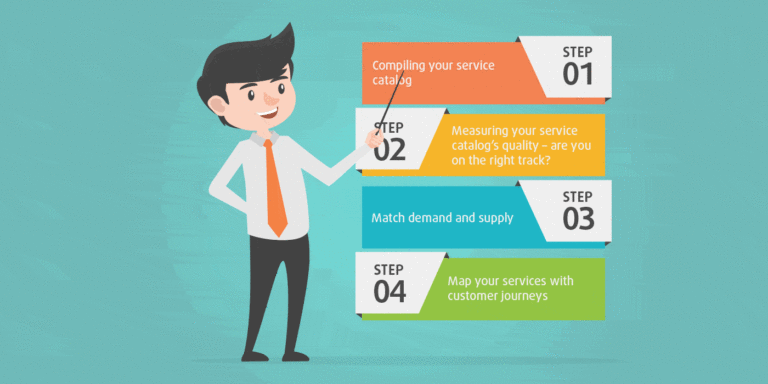
This article offers up a quick guide to service catalog success – from getting started, to measuring quality, from checking whether you’re providing services that meet your customers’ needs, to improving your service catalog by matching it to your customer journeys. Get the lowdown here.
Here Stephen Mann takes his latest negative customer experience and turns it into five simple, but practical, pieces of advice for anyone (whether they be in internal or external support) to follow when handling a customer complaint.
Have you ever stopped to consider the total cost of ownership (TCO) for your current, or next, IT service desk tool? Not just the costs of buying the software but the all-in costs of what it takes to make the tool “fit for purpose” and to maintain this over time? Here we outline all the costs that you need to consider.
How relevant is ITIL right now, especially for IT service desks and service desk agents? If you want some hot-off-the-press insight, new research data from HDI – in its 2018 Technical Support Practices & Salary Report – offers two perspectives on the value of ITIL certification to North American service desk agents.
All sorts of businesses are starting to hold daily team huddles and finding that they’re transforming the way they work. Team huddles not already a part of your workplace culture? This article contains everything you need to know about holding a huddle and what they could do for your IT service desk operations.
How can your IT service desk start using AI-assisted knowledge capabilities to improve the level and quality of its knowledge-sharing success and increase end-user satisfaction? Here we dive into the fundamentals and how to best use this “new” technology.
Corporate IT service desks have long understood the opportunity, and benefits, of knowledge management, but far too many continue to struggle to make the most of what their service desk agents, and the wider IT organization, already know. The question is: why is this?

Should the person you’re asking to approve a change request actually be able to stop a change from occurring, even if everyone else agrees it should occur? This article aims to help you understand who in your organization is best positioned to approve changes.
Do you remember the concept of “follow the sun” service desks? An approach to ensure that there’s always an IT support facility available to employees as and when they need it. This article questions how prevalent 24×7 IT service desks – “follow the sun” or otherwise – are in 2018.
This article aims to provide an overview of the different types of knowledge bases available. The question we want to answer here is: “Is it better for your company to use an internal knowledge base (that’s built into your ITSM tool) or an external knowledge base provided by a third party?”
If you’re not meeting the response time agreements you have with your customers can you explain why? If not, then here’s a potential solution – duration distribution reporting is a strategy that service managers can use to gain a deeper understanding of the lifecycle of a request in your organization. Here we explore…
We must stop treating the processes in ITIL as discrete units, where “paint-by-numbers” is a viable approach, says Kaimar Karu. Remember: it’s not about processes, it’s about value and services, and the “how” of every process or concept matters only when the “why” is first successfully addressed.
Change management processes and procedures should be created from the ground up, with scalability, standardization, risk mitigation, and efficiency all at the core. But when defining your process, how do you know when a change notification is sufficient and when an approval is required for a change?